

Point of View

When the defence speaks, Customs should listen: turning courtroom challenges into learning opportunities

2 March 2026
By Md Shahiduzzaman Sarkar and Kegomoditswe Felicia Ntusa, Anti-Money Laundering and Counter-Terrorism Financing (AML/CTF) Programme, WCO Sec-retariat

In the last decade, the WCO Secretariat has been working with Customs administrations to strengthen their capacity to detect the smuggling of bulk cash, gems and precious metals. Emphasis has also been placed on the advancement of investigations following border seizure events to uncover money laundering schemes behind the goods, and to trace the broader illicit financial flows they generate. One difficulty remains strikingly clear for Customs practitioners in this field: building strong investigations, documentation and procedures which cannot easily be challenged in court. To achieve this, they believe in the need to leverage a powerful and underused asset: the courtroom strategies used by offenders’ lawyers to weaken money laundering and terrorism financing (ML/TF) charges. By “learning from the defence”, money laundering investigators can build cases that are operationally sound and legally effective.

In 2025, officers from the UK Border Force confiscated around £400,000 from a departing traveller who was charged by the National Crime Agency for money laundering under the Proceeds of Crime Act 2002 presenting the cash as criminal property linked to wider offending. Eight months later, after a three-week trial, the jury acquitted the accused[1]. The defence did not need to prove the cash was legitimate. It only needed to show that the case narrative was not coherent and that the evidential trail did not reliably establish illicit provenance or the required knowledge or suspicion.

This is not an isolated incident. Despite many Customs administration having upgraded their legal and operational anti-money laundering and counter-terrorism financing (AML/CTF) frameworks, a critical implementation gap persists. Many times, controls appear compliant on paper, yet fail to be so under adversarial scrutiny in court.

From adversarial challenge to structured learning

Every time a defence team succeeds in excluding evidence, in weakening a money laundering narrative, or in challenging an asset-freezing or confiscation measure, it exposes precise weaknesses in how cases are constructed. Treating these outcomes only as defeats wastes an opportunity. Treating them as structured learning material for investigators transforms them into an engine for strengthening national systems.

This approach has been adopted by the WCO under Project TENTACLE, with the Project team advocating for Customs Academies to incorporate real judicial cases into their training curricula and to use them in preparing the new generation of anti-money laundering and counter-terrorism financing (AML/CTF) investigators.

Analysis of the strategy used by offenders’ lawyers shows that they actively test:

  • whether risk-based measures were clearly defined, consistently applied and properly documented;
  • whether Customs actions respected legal mandates, procedural safeguards and rights; and
  • whether evidence chains, cross-border information, financial and trade records, and digital trails are reliable, admissible and traceable.

“Learning from the defence” can help Customs build litigation-proof cases and, more specifically, perform the actions below.

  • Develop a strong evidence-based case: During an investigation, Customs may collect evidence that links illicit movements of goods, traders, or financial arrangements to money laundering operations or broader illicit financial flow offences. The courtroom then becomes the ultimate test for Customs data, processes, and arguments, which are scrutinized by defence lawyers and judges. Failures to develop a strong prosecutable case can be connected to the inability to produce documents, to incomplete documentation of inspections, weak economic logic, unclear legal mandates for particular actions, weak or missing beneficial ownership information, or a failure to demonstrate a clear connection between trade irregularities and underlying predicate offences. Customs administrations need to internalize these lessons by updating training, refining case templates, and standardizing investigative logic.
  • Reinforce the legitimacy and transparency of their targeting regimes: The risk-based approach is only as strong as the administration’s ability to explain it. The Financial Action Task Force (FATF) and WCO instruments rightly encourage Customs to focus resources where risks are highest, but if targeting criteria are vague, undocumented or inconsistently applied, they become an easy target for defence counsel.[2] In court, what is described as “risk-based” can quickly be reframed as arbitrary, discriminatory, or procedurally unfounded when there is no clear evidential trail showing how and why specific consignments, traders or routes were selected for control. In light of these arguments, Customs administrations must refine profiling models, require written rationales for selections, and embed an auditable chain of analytical reasoning into their systems. A “risk-based” approach must be backed by a demonstrable methodology where every intervention can be reconstructed, defended and aligned with objective indicators and national risk assessments. In doing so, WCO Members not only protect their cases in court, they also reinforce the legitimacy and transparency of their targeting regimes in the eyes of both the judiciary and the private sector.
  • Strengthen inter-agency coordination and evidence chains: Many contested ML/TF cases collapse not because of weak evidence, but because of poor coordination. Customs holds facts at the border. Financial Intelligence Units (FIUs) hold financial intelligence. Police lead criminal investigations. Prosecutors shape the legal strategy. All inputs often reach the courtroom as fragmented stories and incomplete chains of custody. Defence lawyers do not need to disprove the allegations. They only need to expose inconsistencies, procedural gaps, or uncertainty about who acted, when, and on what authority. When records contradict each other, or key decisions lack documentation, the strength of the entire case fades. Studying defence attacks can enable Customs to enhance joint investigation protocols. These should clearly assign responsibilities from the first red flag, ensure systematic documentation, and maintain secure, searchable records that protect the chain of custody across agencies. Prosecutors should also be engaged early in complex Customs-related ML/TF cases to guide investigations. The objective is to get rid of informal exchange practices and replace them with an integrated process that results in a single, coherent case narrative supported by consistent evidence, not by a patchwork that skilled defence lawyers can easily dismantle.
  • Raise the level of professionalism and the reputation of the administration: Rigorous defence scrutiny can also be used as a quality control mechanism for targeting decision, search, seizure, data-query and freezing actions. It forces administrations to separate what is merely operationally convenient from what is legally sustainable, and in doing so, it raises the overall standard of practice. Learning from defence strategies also acts as a safeguard for rights, and a shield for institutional credibility. By examining where courts have found overreach, weak justification or inadequate respect for due process, Customs administrations can recalibrate their methods before such weaknesses become systemic. This alignment of power with restraint is not cosmetic. It strengthens public trust, reassures legitimate traders and passengers, and signals to international partners that enforcement is both robust and rules-based. In that sense, integrating “the defence perspective” is not at odds with WCO values; it is a concrete expression of them, embedding integrity, accountability and respect for the rule of law at the very core of Customs practice.

A tested approach

Under Project TENTACLE, many administrations have tested the approach, with the support of the WCO Secretariat.

Activities have included:

  • examining anonymized case studies based on real investigations involving undervaluation, misdeclaration, bulk cash movements, gold smuggling and other illicit cross-border schemes;
  • reconstructing key defence arguments, such as challenges to documentation, procedural steps, mandates and inter-agency coordination; and
  • undertaking simulation exercises where participants play both the roles of defence counsel and of investigators to ensure that their case can withstand judicial review.

While assessing the impact of these activities, grounded in actual judicial and operational experience, rather than purely theoretical examples, Customs, FIU and police officers indicated that:

  • their understanding of evidential requirements and litigation risk improved substantially; and
  • they became more attentive to documentation discipline, structured narratives and the need to link trade anomalies to financial flows and predicates.

These results suggest that the “learning from the defence” approach is suitable for wider adoption as a structured training pillar for Customs administrations.

Practical framework

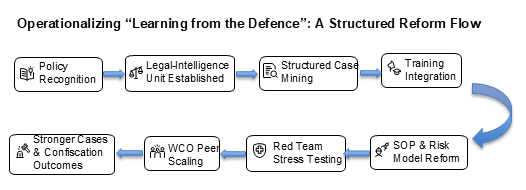
To institutionalize this approach, a practical learning framework would provide for the steps below.

Systematic collection and analysis of cases and judgments

A serious commitment to learning from the defence begins with treating case law as structured intelligence. National and regional money laundering cases with a Customs dimension should be collected and mined systematically for what they reveal about the strengths and weaknesses of existing enforcement practice. This work should be led by a specialized unit within the Customs administration. This could be the legal affairs department or an intelligence-legal fusion team. The officers involved need strong legal literacy and a solid grasp of national AML/CTF laws. They must also understand ML/TF typologies and how they appear in trade data. They must work closely with prosecutors and the FIU to ensure a full picture of how cases evolve, and to see where investigations fell short.

Integration into Customs training

Integrating anonymized, real-life case materials into training is the most direct way to confront officers with the complexity, imperfection and pressure of actual investigations. Structured exercises that require officers first to attack a case from a defence perspective, and then to reconstruct it as investigators, are particularly powerful. Each exercise must be explicitly mapped to relevant international and WCO instruments. This alignment ensures that officers see these standards not as abstract obligations, but as practical benchmarks for building defensible cases.

Development of standard operating procedures (SOPs), checklists, templates and analytical models

“Red teaming” is an exercise that reproduces the tactics, techniques, and procedures used by the adversary. The question is no longer, “Does this look compliant in an audit?”, but, “Could a skilled defence lawyer dismantle this decision, this profile, or this chain of custody in front of a judge?” That shift in perspective exposes gaps that internal designers, working from the inside out, routinely miss. Findings from red teaming must not remain theoretical critiques; they should be translated into concrete adjustments to SOPs, checklists, templates and analytical models. Each targeting decision, escalation, information exchange or enforcement measure should become explainable on demand: why it was triggered, on the basis of what risk indicators, under which legal authority, and with which safeguards. When processes are rebuilt with this level of clarity and traceability, they become both more effective operationally, and more defensible legally.

Leveraging WCO guidance and peer exchange

Existing WCO working bodies such as the Working Group on Revenue Compliance and Fraud (WGRCF), as well as meetings of Regional Intelligence Liaison Offices, and anti-money laundering workshops, have provided the forums to sustain exchange among Customs administrations on courtroom experience, especially on what failed, why it failed, how it was fixed, and how others can avoid the same pitfalls. Thanks to these contributions, the WCO Project TENTACLE team has developed practical templates, analytical methodologies and realistic training scenarios that embed the “learning from the defence” mindset. Customs administrations can draw on these tools to shorten their learning curve and ensure that their reforms are anchored in tested good practices, rather than ad-hoc experimentation.
Call for contributions

Members are also encouraged to continue contributing anonymized lessons from their own contested cases, procedural challenges or appellate decisions, to enable the WCO Secretariat to create a powerful empirical base that can inform new guidance, refine training modules, and highlight emerging patterns in how defences evolve across regions.

Finally, the real power of this approach will emerge when Members begin to document and share its impact. Evidence that it has led to stronger case files, higher-quality prosecutions and more effective confiscation outcomes based on Customs-originated intelligence will validate the methodology and demonstrate that Customs administrations are hardening their stance against sophisticated financial crime. That, in itself, is a strong message to criminals, partners and courts alike.

More information
WCOTentacle@wcoomd.org

[1] https://www.shearmanbowen.co.uk/acquittal-in-international-money-laundering-case-at-isleworth-crown-court/

[2] FATF (2020). Guidance on the Risk-Based Approach to Combating Money Laundering and Terrorist Financing. Financial Action Task Force, Paris.