
In 2008, a case of corruption shook Uruguay’s foreign trade community and shed light on the need to strengthen transparency and oversight within the sector. In response, Uruguay Customs embarked on a modernization project, with integrity constituting one of the fundamental pillars of its reform policy.
In the June 2017 edition of WCO News, the Administration explained how it had gone about signing memoranda of understanding (MoUs) with the private sector. The main objective of these agreements was to establish, in a coordinated manner, a system aimed at countering all conduct which did not follow current regulations, or which could indicate that an act of corruption might have been committed, and at the same time to make every possible effort to combat such conduct, both in the public and private sphere.
In January 2019, the Customs Administration launched the Pilot Plan for the Reception of Complaints to test a new procedure whereby representatives of the organizations that had signed an MoU could file a complaint. The complaints system was extended in March 2020 to all individuals wishing to report acts, omissions, or conduct that may constitute customs offenses, violations, or crimes, or that are contrary to the Code of conduct.
Over the years, efforts have been made to strengthen the system by making it more accessible and user-friendly for the public, while at the same time ensuring the necessary security and confidentiality. This effort has been reflected in a steady increase in complaints since its implementation, demonstrating the growing trust of society in this mechanism.
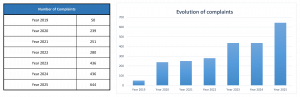
This consolidation and growth process has prompted the expansion and diversification of channels for receiving complaints, with the aim of facilitating access and bringing this mechanism closer to the public.
Currently, complaints may be submitted through the electronic form available on the institution’s official website; by telephone, via the toll-free line 0800-1855; in person, at the Institutional Transparency Department; or by sending the latter an email. In addition, Uruguay Customs receives and processes, within its scope of competence, complaints referred to it by other public bodies.
Within this framework, in June 2023, progress was made in implementing a new complaints management mechanism which allowed not only the registration and processing of complaints, but also the generation of strategic information to support decision-making, risk monitoring, and the design of preventive actions, thereby strengthening institutional integrity.
Measuring impact
These efforts have led to tangible results. In 2025, for the second consecutive year, Uruguay Customs ranked second in the National Transparency and Access to Public Information Index (INTAI), which examines public administrations’ practices related to information access, records and archives management, and open data.
To measure the impact of integrity-related measures in greater detail and inform decisions regarding the way ahead, the Customs Administration created spaces for promoting reflection and dialogue between Customs and business representatives, such as the Customs Integrity and Transparency Conference. This has been held in the context of the International Anti-Corruption Day since 2024, with the conference bringing together 326 participants in 2025.
In 2025, when the WCO launched the WCO Customs Integrity Perception Survey Online Tool (CIPS-OT), the Administration immediately saw how the tool could enable it to better understand how its staff, and the companies with which it interacts, perceive integrity. Uruguay’s first CIPS was completed at the end of that year.
What makes the CIPS unique
The Administration had already been conducting surveys to assess and analyse the level of satisfaction of foreign trade operators and staff members, and from 2011 to 2016 had performed a series of “Work Climate and Job Satisfaction” surveys for its staff.
Moreover, in 2014, a separate survey had been conducted to examine the role of the Customs Administration in foreign trade, and what Government officials and representatives of the foreign trade community perceived as constituting a model Customs administration. The survey results were shared in a report entitled “Image of the National Customs Directorate”.
While these surveys produced valuable insights for the Administration to assess its working environment, their scope and purpose differed from that of the CIPS. The CIPS questionnaires cover the whole integrity improvement framework laid out under the WCO Revised Arusha Declaration. Moreover, they measure only what a Customs administration can improve, or what a Customs administration has the authority to decide or act on.
CIPS Online Tool providing added value
Past experience of conducting surveys enabled Uruguay Customs to run the CIPS independently with the CIPS Online Tool. The experience was highly positive. From an operational perspective, the tool proved to be easy to implement and use. Among its main advantages is the ability to customize the language and adapt the wording of the questions to the national context. Although the on-the-ground data collection method already protected respondent anonymity and data confidentiality, the Online Tool increased the level of trust by not requiring the submission of personal data, and by concealing users’ IP addresses.
The survey was conducted in October 2025 over a period of three weeks, with participation from 319 Customs officers and 331 private sector stakeholders. This level of participation made it possible to ensure margins of error of 4.05% and 4.85% respectively. A margin of error of X% states that the results from the survey may deviate up or down by X% from the actual values that would have been obtained if the entire population had been surveyed.
Communication campaign
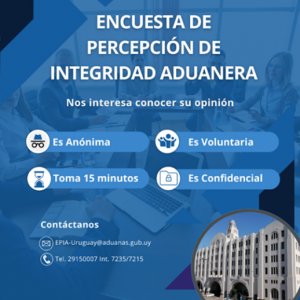 The high level of participation achieved was primarily the result of a carefully planned and phased communication strategy, implemented in line with methodologies previously applied successfully in other projects.
The campaign included meetings with chambers and associations from the private sector; the promotion of collaboration within the framework of memoranda of understanding signed with trade operators; the dissemination of email notifications; and the circulation of alerts through internal systems such as the intranet.
All communication emphasized the voluntary, confidential, and anonymous nature of the survey, as well as the fact that it was administered directly by the WCO through its own servers, thereby ensuring the security and confidentiality of the data collected. This aspect proved to be key in strengthening participants’ trust.
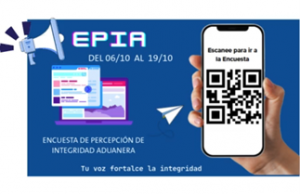
Additionally, a direct link and a QR code were disseminated to facilitate access to the survey, news items were published on the intranet, and interactive pop-ups were used to increase visibility. In the final days of the response period, the campaign was further reinforced through additional email communications and direct outreach to private sector chambers and associations.
As a complementary measure, an institutional video was produced to raise awareness of the importance of the survey and to encourage participation among both Customs officers and private sector operators.
Transparency and managers’ support
The preparation and implementation of the CIPS-OT yielded valuable lessons. One of the main challenges identified was recognizing that an effective communication campaign, on its own, is not always sufficient. It is essential to explain clearly to officials the purpose of the survey, how the results will be used, and their concrete impact on future projects and institutional decision-making.
Another key aspect was the role of middle management. Their engagement and understanding of the survey’s objectives proved decisive in effectively conveying information and motivating participation among the staff under their supervision.
These lessons reinforce the importance of clear, transparent, and two-way communication, as well as of committed leadership at all levels of the organization.
Areas for improvement and feedback received
While the analysis of the results is ongoing, several priority areas for improvement have already been identified. Among these, particular emphasis is placed on the need to enhance the visibility of existing reporting channels, as well as to publish more accessible and widely disseminated information regarding the number of reports received, their classification, the available reporting mechanisms, and the status of their processing.
In addition, in order to strengthen the trust of all stakeholders in the system for receiving and handling reports, the need has been identified to review and adjust certain stages of the reporting intake procedure, as well as to continue moving forward with the implementation of a non-retaliation policy for reporting persons.
From a regulatory perspective, the results highlight the need to strengthen training initiatives, adopting an approach that enables officials to better understand and apply the rules in a simpler and more predictable manner, thereby reinforcing legal certainty and procedural consistency.
Next steps
CIPS constitutes a strategic tool for understanding perceptions regarding integrity-related efforts. In this regard, collaborative workshops with Customs officers and private sector operators are planned for 2026, aimed at deepening the analysis of the results and identifying the underlying causes of the perceptions identified.
The feedback emerging from these initiatives will be a key input for guiding the next stages of work. This participatory methodology will also be applied to the various activities comprising the Institutional Integrity Plan, which include updating the Code of Ethics; developing regulations related to conflicts of interest; mapping corruption risks; and implementing specific actions to mitigate them.
By continuously fostering the participation of representatives of the foreign trade community and government entities in the implementation of the Integrity Plan, Uruguay Customs will consolidate a culture grounded in integrity among all stakeholders, and foster a Customs system that is more transparent, efficient and reliable.
More information
Contact the author
www.aduanas.gub.uy