

The problem is that this verification remains a manual and time-consuming process, one that often requires making a phone call or sending an email to the issuing authority. Communication with the issuing authority can be lengthy and complicated, in particular if an overseas authority is involved and if interlocutors do not share the same language.
Some service providers offer solutions enabling verification through back-end systems. Yet these often involve high maintenance costs, significant resource investment across the logistics chain and complex account management. Most challengingly, concerns regarding data privacy, data ownership, system security and disaster liability further complicate the negotiations over data exchange between authorities and logistics operators.
These challenges intensify when the authority requiring the authenticity check is situated in another country, especially if local privacy and data protection laws rigidly regulate or restrict information sharing at the international level.
ValidAP: a simple and targeted solution
To overcome these difficulties, Hong Kong Customs has developed a blockchain-based digital platform that facilitates real-time, simple and reliable cross-border validation of digital trade documents.
The platform, called ValidAP, supports digital documents of any file type, including .pdf, .docx and even .jpg, and is applicable to all forms of documentary proof such as licences, permits, certificates of origin, laboratory reports, work reports, health certificates, qualification certificates and more.
Issuing agencies that sign up to the platform gain access to a content management system (CMS) to register their digital documents on ValidAP. Signing up is free for authorities situated in the WCO Asia/Pacific region.
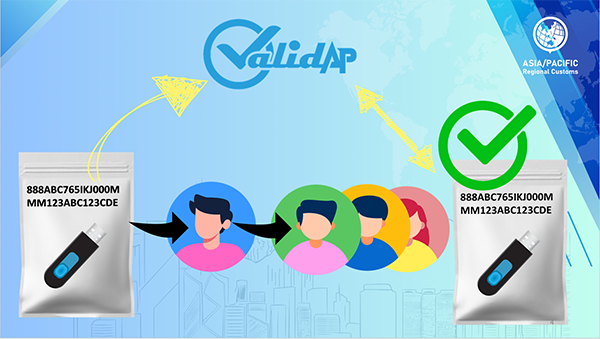
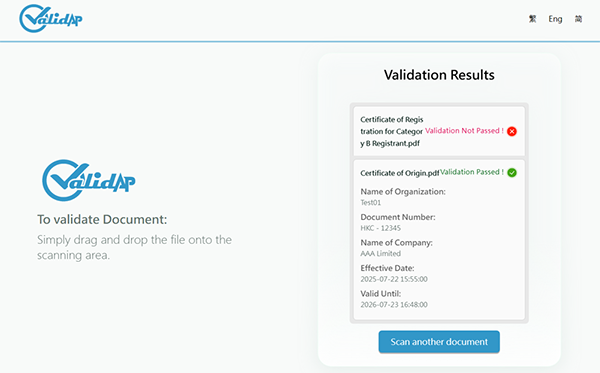
The party that receives this document (e.g. importers, exporters, brokers, Customs at the destination or even bank and insurance companies handling the financial processing), no matter in which part of the world, can simply drag and drop the file onto the ValidAP public portal to verify its validity in real time.
ValidAP uses an open-source cryptographic tool to calculate a unique “hash” value for the digital document. The file itself is never uploaded or transmitted over the internet; only the calculated hash result is stored on the ValidAP blockchain for validation purposes. A “hash” is a string of symbols containing no document content and obtained by an algorithm that prevents reverse engineering of the original document from the hash. Any tiny change to a document will result in a completely different hash value, and, as such, it serves as proof of an exact copy of the original digital document. The “hash” can be regarded as the document’s unique “digital seal number” and is the only data ValidAP needs in the verification process.
The party receiving the document can verify its authenticity by dragging the file onto the scanning area of the ValidAP public portal. The system will calculate its hash value locally in the browser, without any need to transmit the file. By successfully matching this re-calculated “hash” against the “seal number” already stored on the blockchain, ValidAP can confirm that the digital document is an untampered exact copy of the original issued by the genuine authority.
To ensure integrity, ValidAP incorporates a user account hierarchy, an approval workflow for hash submission, two-factor authentication, email domain restrictions and strong password policies. Hong Kong Customs will also assist participants in establishing a direct system-to-system Application Programming Interface (API) connection, allowing their internal systems (e.g. a national trade Single Window) to submit hashes automatically, eliminating human interference and error.
Benefits
A key advantage of the platform (and a major difference from other platforms) is that it does not require any disclosure of document data or content. This is a commitment undertaken by Hong Kong Customs and is inherent in the technical design. It eliminates the need for complex legal negotiations and minimizes data breach risks.
ValidAP’s greatest features are its openness and simplicity: stakeholders across the globe can verify documents on the ValidAP public portal without having to log in. A simple drag and drop answers the critical question: “Is this the authentic copy from the issuing authority?” ValidAP can dramatically shorten decision-making processes for authorities and businesses, whether for admitting food items or animals into their territory under a health certificate, granting tariff exemptions under a free trade agreement, allowing goods to be carried on board under a safety certification, approving letters of credit issued by banks or providing freight insurance. With the ValidAP service, global trade and logistics become faster and smoother.
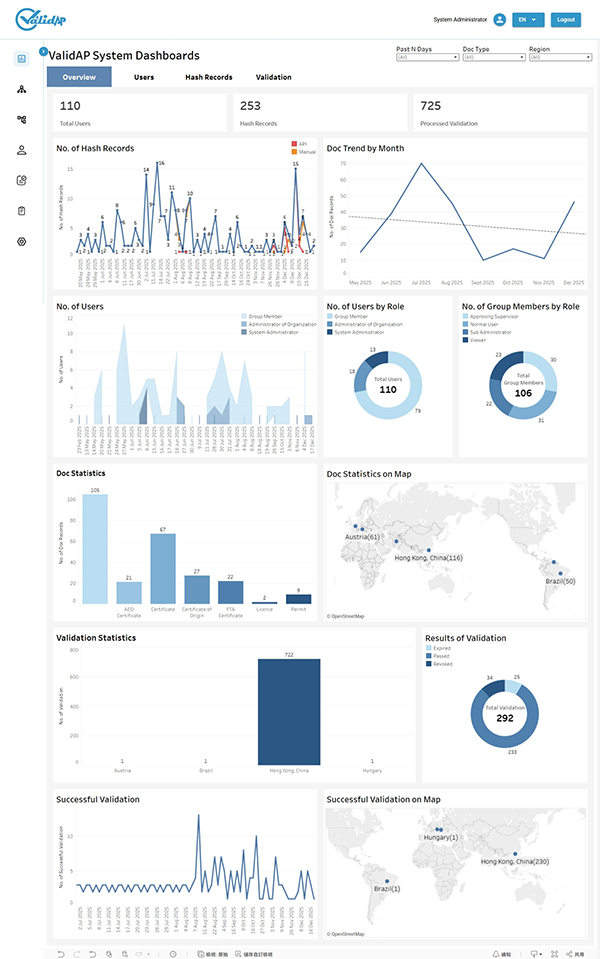
ValidAP also provides issuing agencies with a dashboard containing all necessary statistics to measure achievement and performance, including data on the locations of parties verifying the authenticity of their documents and the number of successful validations displayed on a world map. These statistics are updated frequently and can serve to demonstrate the digitalization progress of the organizations involved. Participating authorities can also benefit from reduced costs for paper, storage and manpower associated with communicating and responding to verification enquiries.
A practical use case
In May 2025, a trial was conducted with the assistance of China Customs and Thai Customs. A consignment of electric cable was sent from China to Thailand via Hong Kong, China. China Customs issued a certificate of origin (COO) and registered its hash on ValidAP. The exporter received the e-copy of the COO and sent it via email to Hong Kong Customs and Thai Customs for clearance. Both Customs administrations successfully verified the authenticity of the e-copy through the ValidAP public portal. As a result, the import tariff into Thailand was reduced from 10% to 0% under the ASEAN-China Free Trade Agreement.
Project deployment, cost and governance
Deployment of ValidAP can be swift. Once approved, an issuing agency can start registering its digital documents through its user account immediately, while establishing an API connection with its domestic IT system can take mere weeks to complete. The extendable blockchain structure allows participating agencies to host their own node with an identical set of shared ledgers. This offers an advantage in forming a blockchain consortium in order to enhance mutual trust between participating agencies.
Hong Kong Customs has absorbed all system development costs and offers participation free of charge. The cost of the initial API connection will also be borne by Hong Kong Customs, with technical assistance provided.
Access to ValidAP is limited to approved trusted authorities and stakeholders. A comprehensive governance framework, including terms of reference (ToR), technical specifications and a user manual, has been developed, and Hong Kong Customs signs a memorandum of understanding (MoU) with each participant.
Join us
ValidAP is now technically ready for operation. The project has been introduced at various meetings in the Asia/Pacific region and at the WCO Permanent Technical Committee meeting in October 2025. It has received very positive feedback, and Hong Kong Customs hopes that Customs administrations and other issuing agencies will contact it to benefit from the ValidAP service.
More information
Contact the author