
More recently, work has been carried out to align GRA performance measurement with the WCO PMM indicators and processes. This was regarded as key to strengthen the work completed in the above areas, as well as ongoing work related to the implementation of Coordinated Border Management (CBM) and the implementation of an Authorized Economic Operator (AEO) programme.
Building performance measurement capacity
“Gambia acceded to the WTO Trade Facilitation Agreement in July 2017 and the WCO Revised Kyoto Convention in June 2023, committing to global Trade Facilitation and Customs standards. By implementing the WCO PMM, GRA is strengthening its ability to monitor performance, improve operational efficiency and align with international obligations”, explained GRA Commissioner General Yankuba Darboe, welcoming the collaboration with the Accelerate Trade Facilitation Programme on the PMM implementation.
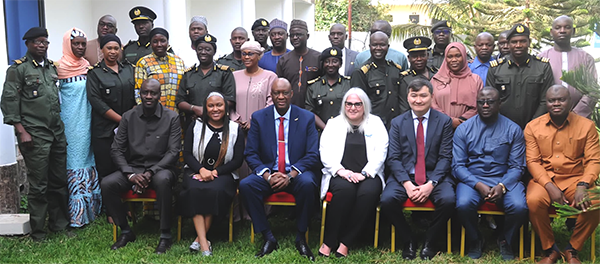
A training session brought together a broad cross-section of stakeholders within the Authority, with the objective of ensuring wide institutional ownership and shared understanding of the WCO PMM framework.
Through this engagement, GRA gained:
This foundational capacity development positioned GRA to adopt the WCO PMM not as a parallel reporting tool but as an integral component of its performance management framework.
Aligning with the WCO PMM
GRA’s Strategic Plan outlines four key strategic domains and objectives:
The WCO PMM pivots around four dimensions:
One key challenge was integrating the “Enforcement, Security, and Protection of Society” dimension into GRA’s performance measurement system, as it was absent from the Strategic Plan. The issue was resolved by incorporating this dimension into the Trade Facilitation strategic domain, the rationale being that facilitating legitimate trade led to improved risk management capacities.
Each dimension was divided at the time into 23 expected outcomes with 51 corresponding KPIs. Many administrations already have a national performance measurement system in place and therefore only need to add those KPIs that are not yet covered by their system. Customs administrations can choose not to use a KPI if it cannot be measured due to national specificities.
GRA choose to integrate 29 of the PMM KPIs as follow (new PMM KPIs are indicated in blue):
Trade facilitation:
Internal efficiencies:
Culture transformation:
One major improvement resulting from the PMM integration was the development of clearer, more precise definitions for each strategic KPI. This clarity will eliminate ambiguity and ensure consistency in performance evaluation over time and across benchmarking exercises with other administrations. This will support GRA in ensuring credible measurement, transparent reporting and effective monitoring of reform progress.
Since successful strategy execution depends on tracking and evaluating “business as usual” activities, the adoption of PMM operational KPIs will strengthen GRA’s ability to monitor daily Customs operations, assess implementation of reforms and ensure alignment with strategic goals.
Areas of improvement identified
One area of improvement that has been identified is Coordinated Border Management (CBM), anchored in Article 8 of the WTO TFA and in many WCO instruments. In this context, in May 2025 GRA partnered with the WCO Accelerate Trade Facilitation Programme to translate strategic objectives into concrete operational reforms at the border that would have a positive impact on the realities that traders and border agencies face on a daily basis.
The focus was on modernizing border procedures and processes in line with the WCO CBM Guidelines and harmonizing border agencies’ data requirements through alignment with the WCO Data Model. Under the umbrella of Gambia’s National Trade Facilitation Committee (NTFC), a series of technical activities supported the re-engineering of border-related business processes and the harmonization of data requirements across key regulatory agencies.
Using WCO tools and methodologies, participating agencies streamlined regulatory documents, reduced data duplication and aligned national datasets with international standards, resulting in a harmonized national data catalogue compatible with ASYCUDA. Another key outcome was the development of an Inter-Agency Standard Operating Procedures Framework for border procedures. Together, these reforms lay a strong foundation for coordinated information flow, integrated risk management and more efficient, transparent border operations.
The development of an AEO Programme was also identified as a priority project enabling GRA to comply with the provisions of the WCO SAFE Framework and WTO TFA Article 7.7. GRA partnered again with the WCO Accelerate Trade Facilitation Programme to design the AEO Programme. The objective was to establish a comprehensive security-focused programme aligned with international standards and underpinned by a sound legislative framework and operational procedures, including AEO Regulations, an AEO Manual, standard operating procedures and supporting documents. The draft AEO Manual and SOPs have already been approved by the GRA Management Committee for pilot testing, with several companies volunteering to participate. The pilot will test the full AEO lifecycle, including application, risk analysis, validation and benefits management – resulting in tangible changes for business and enhanced public-private partnership.
To further strengthen implementation, the WCO has facilitated regional peer-to-peer learning for GRA’s AEO team, drawing on Nigeria’s experience following its AEO launch in February 2025. Insights from this exchange informed GRA’s pilot, which is scheduled to commence early this year (2026).
GRA’s PMM journey
GRA recognizes that effective and sustainable implementation of the WCO PMM requires a long-term institutional commitment, underpinned by a sustained culture of collaboration across all GRA departments. Therefore, as GRA continues to advance its Customs modernization and reform agenda by leveraging on the WCO PMM, the Authority recognizes that continuous engagement remains essential to ensure every stakeholder understands the value of the PMM and the methodology behind measuring each performance area and indicator. In this regard, GRA has established an Internal PMM Committee, which serves as a working group and meets regularly to discuss PMM-related issues.
While internal alignment is indispensable, the participation of external stakeholders within the trade facilitation value chain is equally critical. Their involvement plays a pivotal role in strengthening CBM and enhancing the effectiveness of the AEO programme, as described previously. GRA, as Chairperson of the National Trade Facilitation Committee (NTFC), which brings together all stakeholders within the trade facilitation ecosystem, therefore plans to engage the NTFC to understand and support the PMM.
In addition to stakeholders’ engagement, a cornerstone of the PMM’s successful rollout has been the strong political will and leadership commitment demonstrated by GRA management from the outset. GRA leaders quickly recognized the value of the PMM and committed the necessary resources, time and strategic oversight to integrate it effectively. This was driven by a clear understanding of how the PMM aligns with and could potentially strengthen the Authority’s 2025-2029 Strategic Plan implementation, which is anchored in operational efficiency and strategic effectiveness achieved through robust performance measurement.
As of the end of 2023, and every two years thereafter, WCO Members have been invited to participate in the WCO PMM by submitting data via the WCO PMM online platform. Although GRA missed the opportunity to participate in the first cycle, the Authority will be participating in the second cycle which started at the end of 2025. It also joined the Performance Measurement Mechanism Project Team (PMMPT) at its 3rd Meeting. This enabled it not only to share its experience, but also to significantly boost its understanding of the mechanism.
Data challenge and digital foundations
GRA recognizes that the effective and sustained implementation of the WCO PMM relies on two key pillars: addressing the challenges associated with providing data and ensuring that the selected PMM KPIs are properly defined and, where necessary, simplified.
To ensure data availability, reliability and validity, GRA is preparing to implement a project on “Harnessing Data Management”. This includes the development of a robust data warehouse intended to integrate all systems across the Authority, many of which currently operate in silos. The goal is to optimize the use of data through Business Intelligence tools to measure performance, track progress and support informed policy decisions.
To support this effort, a comprehensive Data Governance Framework has already been developed. Once operational, the system will not only address existing gaps in data essential to sustaining the WCO PMM platform and similar initiatives but also advance the Authority’s wider digital transformation agenda.
What is next?
By embedding clear performance indicators, structured measurement processes and internationally comparable benchmarks, the PMM provides GRA with a robust framework to track progress, inform decision-making and demonstrate results. In doing so, it reinforces GRA’s commitment to transparency, continuous improvement and effective service delivery in support of national development objectives.
Having successfully identified and mapped the PMM KPIs and expected outcomes against the objectives of its Strategic Plan, the Authority will now advance to the next critical step of providing data inputs to the PMM platform. To ensure long-term success and sustainability of the PMM, GRA will continue to:
Through these efforts, GRA remains committed to using the PMM not only as a measurement tool but also as a strategic asset that supports modernization, enhances performance and improves service delivery across the Authority.
More information
Contact the author