Focus on digitalization
From 2020 to 2024, the Customs Administration consistently digitalized its processes. Pursuant to the Resolution of the Cabinet of Ministers of the Republic of Uzbekistan, dated 5 February 2021, “On Approval of the Regulation on the Procedure for Conducting Customs Audits”, the Customs Audit Department was established. Within this Department, the number of employees was doubled and a strong team possessing in-depth knowledge in data science, artificial intelligence technologies, and Customs legislation was created.
These specialists have already developed 176 software products, including 37 automated information systems, 41 interactive services, and 11 mobile applications. The WCO Data Model has been used as the underlying framework for the purposes of data harmonization and information exchange with IT systems run by other agencies or in other countries.
To financially incentivize individuals engaged in scientific research to work on the development of analytical models and their testing with the Customs administration, grant projects have been created by the Agency for Innovative Development. This approach not only contributes to the improvement of existing models, but also facilitates the development of new, more effective detection methods.
Simplifying exports
A major achievement in 2024 was the launch of the “Export in Three Steps” electronic information system. This system has radically simplified export procedures, replacing the previous nine-step clearance process with a three-step integrated one, as follows:
The impact of the new procedures has been substantial: the number of business entities engaged in export activities increased by 4% in 2025, with 375 new organizations gaining access to international markets. Export of food products increased by 37%, export of metals and metal products by 30%, and export of chemical industry products by 34%.
Moreover, the average time required to complete Customs and foreign trade-related formalities was reduced from one day to one hour. At the same time, export-related costs decreased by an average of 35%.
For representatives of exporting organizations, the key advantages of the new system are its transparency, speed, and ease of use. In a survey conducted at the end of 2024, 87% of the respondents reported a significant improvement in their level of satisfaction with Customs procedures.
Automating clearance
To speed up the clearance process and reduce the discretionary practices of Customs officers, the auto-clearance system was launched in test mode in September 2022, before becoming fully operational from April 2025.
The system operates in two stages. First, automatic data verification is conducted, with the system analysing declaration data, based on specific parameters: the declarant’s previous activities, origin and value of goods, HS code, and logistical route information.
Second, risk assessment is carried out using three types of machine learning models designed to identify patterns and make predictions based on data:
Following the introduction of the auto-clearance system, manual processes have been reduced by 75%, and the time required for clearance by 42%. The system’s automation eliminates the need for Customs inspectors to deal individually with each declaration, allowing controls to be organized based on objective criteria, reducing the likelihood of subjective decisions, ensuring transparency, and eliminating corruption risks.
E-TRANSIT system
Uzbekistan plays a crucial role as a transit country in the Middle Corridor, a multimodal trade corridor that connects Central Asia with European markets. It also envisions becoming a key contributor to regional trade in Central Asia, fostering a dynamic, efficient and inclusive trade ecosystem.
Unlike clearance, which happens in one place, transit requires the exchange of information from at least three places: that of transit initiation; that of transit termination; and that of the guarantor (to validate and discharge the bonds).
To facilitate transit operations through the country, an electronic transit system called “E-TRANSIT” has been introduced. The system enables trade operators and border control agencies to complete online, through a single information system, all procedures related to entering and leaving Uzbekistan. Electronic seals fixed on containers enable them to follow the status of the shipments in real time.
In addition, the Republic of Uzbekistan continues to actively participate in initiatives aimed at facilitating regional transit within the framework of the Central Asia Regional Economic Cooperation (CAREC) Program. In 2026, it will pilot a unified regional transit management system for road transport among the Republics of Azerbaijan, Georgia, and Uzbekistan.
These measures are aimed at deepening Uzbekistan’s integration into regional and international transport and logistics systems, enhancing its transit potential, and creating favourable conditions for foreign trade flows.
Impact
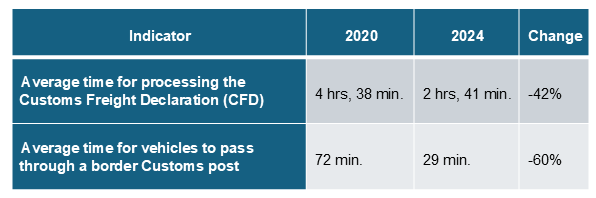
To assess the impact of the digitalization of Customs procedures and of the automated risk management system leveraging machine learning, various performance indicators have been used.
They include the time required to clear a Customs declaration, which decreased sharply between 2020 and 2024, as well as the time for vehicles to cross the border.
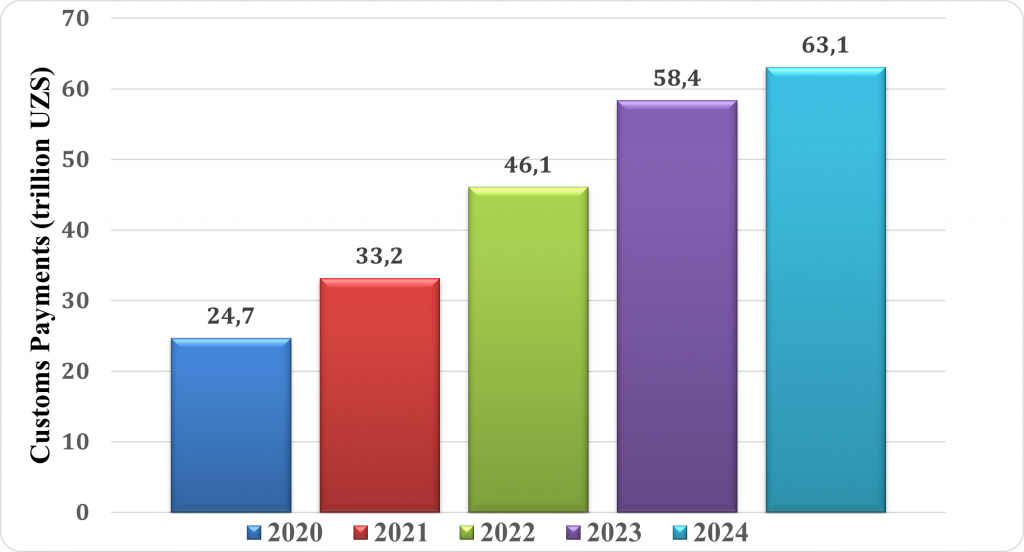
The digitalization of Customs processes and the introduction of a risk management system have led to a significant increase in revenue collection. Customs payments, which amounted to UZS 24.7 trillion in 2020, reached UZS 63.1 trillion in 2024. This indicates that Customs revenues increased by 2.6 times over a five-year period (Figure 1).
At the same time, the introduction of automated systems within the Customs authorities of Uzbekistan has eliminated the need for Customs inspectors to apply an individual approach to each declaration, enabling control to be carried out based on objective criteria, reducing the likelihood of subjective decision-making, ensuring transparency, and mitigating corruption risks. As a result, the occurrence of legal disputes between Customs authorities and trade participants has been significantly reduced.
In particular, while 233 disputed cases related to Customs clearance were examined by economic and civil courts in 2020, this figure declined to 130 cases in 2025. This change is primarily attributable to increased transparency in Customs procedures and the enhanced objectivity of decisions adopted through automated systems.
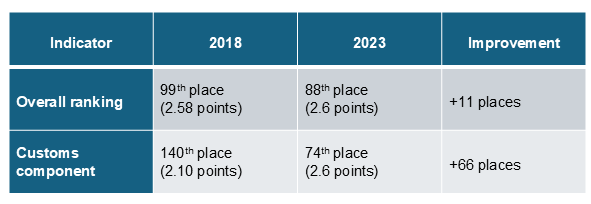
The impact of Uzbekistan’s Customs reform is also reflected in the World Bank’s Logistics Performance Index (LPI), with the country moving from 99th place in 2018 to 88th place in 2023. In the “Customs Efficiency” component, it has greatly improved its position, jumping from 140th place to 74th place.
Uzbekistan’s Logistics Performance Index Indicators (2018, 2023)
In terms of corruption, it is worth noting that the “Openness Index 2024”, conducted by the Anti-Corruption Agency of the Republic of Uzbekistan, ranked the Customs Administration 5th among 98 organizations under the criterion “Assessment of the use of transparency principles in the early detection and prevention of corruption cases”.
The Customs reform is also considered as one of the main projects which has enabled the significant improvement in Uzbekistan’s ranking in the 2024 Corruption Perceptions Index (CPI), published by Transparency International. Uzbekistan’s score has increased by 9 points, with it ranking 121st out of 180 countries. This is the highest movement in the Central Asian region.
Success factors
Whilst the Administration has benefited from the support of international organizations, including the WCO, the success of the reform has primarily been due to high-level political will and the resolute support of the Administration’s leadership. President Shavkat Mirziyoyev has personally supervised the elaboration of the reform strategy, and is monitoring its implementation through quarterly meetings. A results-oriented approach has been adopted by all officers involved, who are each allocated specific tasks to ensure prompt decision-making, as well as accountability. Over the last four years, 41 resolutions and decrees aimed at improving Customs activities have been adopted.
Another critical factor in Uzbekistan Customs’ digital transformation is the adoption of a competency-based approach to human resource management. Between 2021 and 2024, the Administration trained and retrained staff on modern management techniques, risk analysis, and data-driven decision-making, with the support of the WCO and other organizations. A total of 1,690 employees completed at least one course on the WCO CLiKC! training platform, and 450 employees participated in WCO workshops or training. Moreover, most of the newly hired officers are IT specialists, creating a new generation of Customs officers who are proficient in digital technologies, and skilled in digital analysis and in working with artificial intelligence.
The implementation of new analytical models has significantly enhanced the capacity to identify Customs law violations, intensifying the need to further strengthen investment in the post-clearance audit system. Again, with the support of the WCO and other international organizations, during 2025, new training programmes for Customs audit personnel were organized, with foreign experts conducting 21 seminars and 11 training sessions on Customs audit.
Moreover, Customs officials who succeed in identifying commercial fraud and preventing the illegal movement of goods across the Customs border are now rewarded. Starting from 2026, incentive mechanisms have also been introduced for business entities which receive positive evaluations based on the results of Customs audits, i.e. those entities which fully comply with legislative requirements.
Future prospects
According to the WCO Digital Customs Maturity Model, the Customs Service of the Republic of Uzbekistan is in the third stage – the consolidation stage – of the five-stage model.
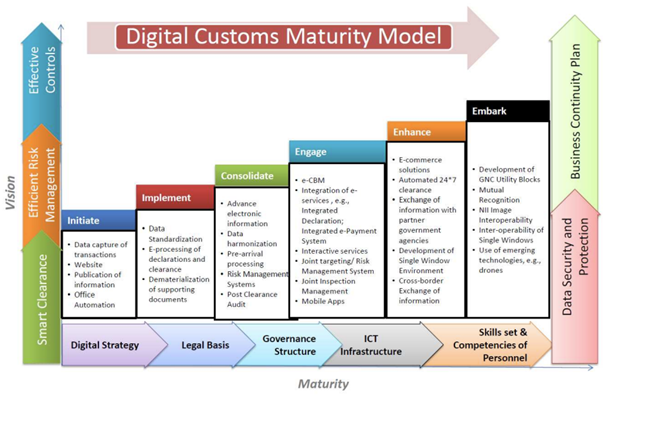
Key outcomes can be summarized as follows:
The objective is now to achieve the fourth stage of the WCO Digital Customs Maturity Model – the engagement stage – by 2027.
The widespread introduction of artificial intelligence technologies has been planned to further automate procedures and improve Customs valuation controls. The objective is to ensure 95% accuracy in goods classification and improve the capacity to detect commercial fraud cases. A “Customs Advisor” chatbot will also be launched to respond to information requests from citizens and businesses.
This stage will not only see the introduction of fully automated decision-making mechanisms in Customs operations and predictive analytics, but also integration with foreign Customs and trade information systems.
Currently, information related to certificates and permits is securely exchanged at the national level via the “Single Window” platform, using encrypted communication channels, role-based access rights, and audit mechanisms. In this system, each agency retains ownership of its own data, while the Customs authorities make final decisions regarding Customs clearance of goods, based on the certificates entered into the system.
In the near future, the various certificates, permits and forms used by border agencies will be aligned with international standards, using the WCO Data Model. This initiative will cover, in particular, documents issued by the sanitary-epidemiological service, veterinary control, quality control authorities, and environmental protection agencies. This move will facilitate the work of trade operators and enable swift exchange of information with foreign entities.
More information
Contact the author
[1] World Bank, Doing Business 2020: Comparing Business Regulation in 190 Economies – Economy Profile of Uzbekistan https://documents1.worldbank.org/curated/en/880291575378502051/pdf/Doing-Business-2020-Comparing-Business-Regulation-in-190-Economies-Economy-Profile-of-Uzbekistan.pdf