
Design and development began quickly, with early decisions focused on data ingestion, how to structure the processing pipeline, and how to combine rules-based controls with analytics where appropriate. By the end of Day 1, each team had a working plan and an initial build underway.
Day 2 was devoted to implementation: cleaning and structuring data, refining HS classification approaches, implementing logic gates, and connecting outputs to dashboards or simple user interfaces.
Work progressed through rapid iteration – testing, debugging, and tuning performance – while teams prepared a coherent narrative for the final demo. By the close of Day 2, most prototypes had been finalized. They were able to ingest the order data stream, execute the decision logic, and display results in a way that enabled officers to understand the results and inform decision-making.
Day 3 was a short but decisive final stretch during which the teams focused on the stability of their prototype and the development of clear visualizations and concise storytelling.
Five teams, five approaches
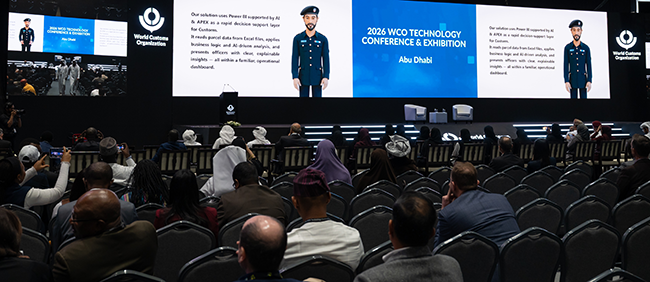
Although the prototypes tackled the same mission, they each had a distinct philosophy and toolset.
National Legends (UAE – ICP) – Advance data as a backbone
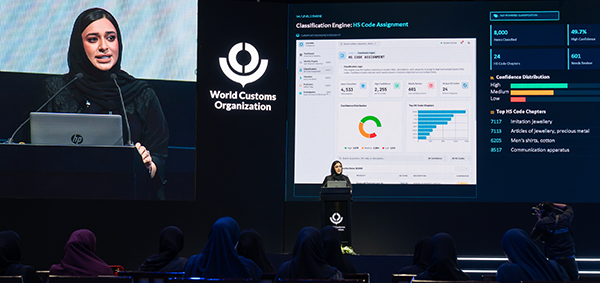
The team called “National Legends” emphasized a core principle echoed throughout the hackathon: the strategic value of advance electronic data. Their “Customs Intelligence Dashboard” contained four functional engines aligned with specific actions: Identify, Classify, Evaluate, and Protect.
A notable feature was their HS code assignment approach. They presented a classification engine leveraging Natural Language Processing that not only generated classification suggestions but also covered confidence levels and “needs review” cases. This reinforced an operationally important point: automation at scale works best when it is paired with transparency about quality and uncertainty, so that officers can focus attention where it adds most value. In addition, their solution displayed all risks (split shipments and high-risk shipments) related to a shipment on one single screen.
ICP Codebreakers (UAE – ICP) – Project Mijass
The team called “ICP Codebreakers” developed a solution nicknamed “Mijass”, an Arabic term meaning a probe or early risk detector. Their solution stood out for how clearly it reflected a “command centre”. Their dashboard demonstrated end-to-end processing across a large dataset, with headline indicators such as “Revenue Recovered (L3)”, “Security Threats (L4)”, and “Split Shipment Rings (L1)” presented as analytical outputs. The interface also highlighted performance and efficiency considerations, signaling that speed and cost matter when solutions must scale to high volumes.
Dhabi71 (UAE – Abu Dhabi Customs) – Power BI decision support with explainability
The team called “Dhabi71” introduced an AI persona (“Hamad”) as a decision-support prototype. Their design philosophy was that the system should not be a black box. Their dashboards were structured around operational needs, offering drill-down views that resembled an auditable case file per parcel. This allowed officers to see why a decision was made by linking specific risk flags, classification and valuation outputs, and tariff impacts into a single, coherent view.
B’Odogwu (Nigeria) – Parcel-Intel
The Team called “B’Odogwu” developed a prototype called “Parcel-Intel” positioned as an automated intelligence engine with a practical workflow: upload CSV, auto-process a four-gate pipeline, view dashboards, generate reports, and export enriched data. They emphasized architectural considerations such as memory-efficient processing to handle very large volumes on standard infrastructure. Their solution also highlighted “real-time risk lane assignment” as a way to translate complex analytics into actionable operational routing. In the “real-world impact” framing, they stressed high automation potential, accurate duty calculation, and the ability to focus inspections where needed while still processing high volumes.
AD Ports Digital (UAE – AD Ports Group) – Accelerating delivery with GenAI-enabled tooling
The team called “AD Ports Digital” focused on delivery speed and data quality – a major constraint in e-commerce, where product descriptions can be convoluted, inconsistent, or incomplete. Their presentation highlighted an iterative implementation approach (data preparation, pipeline building, dry runs, and refinement) and demonstrated how GenAI-enabled tooling can accelerate tasks like structuring, enrichment, and classification.
Rather than treating AI as a single “magic step”, their approach positioned it as a practical accelerator across the workflow: improving data readiness, supporting classification logic, and enabling rapid iteration under severe time constraints. This emphasis on iteration and tooling maturity aligned well with hackathon realities: the ability to move from raw data to a coherent pipeline is often as important as any single model choice.
Inside the engine: how the logic identified risk shipments
While teams used different interfaces and technologies, the core of the hackathon lay in the logic used to process the order data stream and identify behaviours described in the mission brief. The challenge was not only about handling volume, but about producing decisions that were consistent, explainable, and defensible.
A critical feature was the ability to detect split shipments designed to remain below the specific value thresholds allowing tax exemption and simplified procedures in some countries. The scenario reflected a common pattern observed in e-commerce flows: placing multiple orders under the same identity on the same day to remain eligible for simplified processing. To counter this, the teams built aggregation logic that grouped orders using combinations such as “Importer name + Delivery address + Date” and computed daily totals against those identities. This enabled systems to flag threshold breaches that manual checks would be likely to miss.
The protection and safety dimension was equally important. Teams were required to flag restricted items regardless of value. Systems scanned descriptions for indicators linked to risk profiles (for example, lithium batteries or bladed articles), enabling rapid segregation of higher-risk goods from compliant flows.
Teams delivered functioning prototypes rather than static mockups. They developed browser-based applications capable of uploading the order stream, executing the challenge logic, and visualizing results quickly. Some teams also showcased how no-code platforms / AI-assisted development can accelerate delivery of applications (frontend and backend / databases) based on specific business needs without writing a single line of code.
From prototype to roadmap
The hackathon also served as a platform for showcasing forward-looking ideas and testing strategy – exploring how data, decision logic, and user-centred design can translate frameworks into implementable operational concepts.
National Legends reinforced a strategic vision for decision-quality at scale, emphasizing how advanced electronic data can become a backbone for both facilitation and enforcement. Parcel-Intel highlighted extensibility, including how HS rules, risk keyword sets, and integration patterns could evolve over time. Other teams positioned their prototypes as steppingstones toward broader modernization, where interoperability and trusted data exchange across borders and supply chain actors become essential for sustainable outcomes.
Awards
As the Conference concluded, each team presented its solution to conference participants and a jury composed of the panellsts from Session 8 on e-commerce, representing both Customs administrations and the private sector.
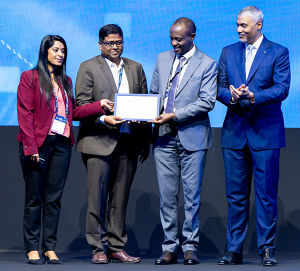 Conference participants and the jury were asked to vote for their favourite prototype. The audience award went to Dhabi71and the jury award to AD Ports Digital.
The hackathon showed that innovation can be built, tested, and demonstrated within 48 hours when professionals and experts collaborate around a clear operational use case. It validated the hackathon as a practical model for problem-solving in the Customs domain, yielding prototype solutions to pressing challenges while fostering a community of innovators and a spirit of continuous improvement.