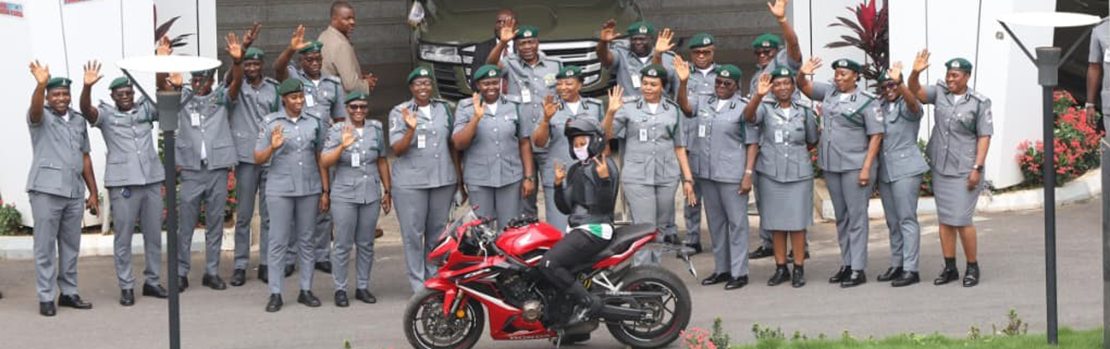
Riding Beyond Borders: A Customs Officer’s Journey Through Africa and Europe
1 March 2026
By Akpevwe Attracta Ogboru, Deputy Comptroller of Customs, Nigeria Customs Service (NCS)From 21st August to 10th October 2025, Akpevwe Attracta Ogboru travelled by motorbike from Lagos to Brussels to deepen her understanding of how borders operate and what travellers and traders, especially women, experience. In this article she explains her motivation and what she learned on the road, not only about how borders work, but also about herself and humanity.
I often say that my journey in Customs began long before I was officially hired in 2011. Growing up, I was naturally drawn to structure and order, and I liked the idea that systems could shape society. The turning point came during my university years. I studied French at Delta State University Abraka and later earned a Master’s degree in International Law and Diplomacy from the University of Jos. Those disciplines opened my eyes to the dynamics of borders, trade, and international cooperation.
So, when the opportunity to join the Nigeria Customs Service came, I did not hesitate to take it. Joining Customs meant I could serve my country in an institution that sits at the heart of national security, trade facilitation, and economic development. Over time, my roles across different commands strengthened my resolve: this was more than a job – it gave me a purpose and enabled me to continuously learn.
Building a career and navigating challenges as a woman
My career path included postings in administration, operations, enforcement matters, trade facilitation policy, post clearance audit. Etc. At every stage, I learned something new about the complexity of border management.
As a woman, I faced challenges — sometimes subtle, sometimes pronounced.
Occasionally, people doubted my abilities simply because of my gender.
But I learned to let my work speak. Thoroughness, professionalism, and dedication have a way of silencing skepticism. That’s how I earned respect within the Nigeria Customs Service and beyond.
The rider behind the uniform
Motorcycling came into my life unexpectedly. I was tired of spending hours on a bus while commuting to work when I was based in Lagos, so I decided to learn to ride a motorcycle. I went to a riding school, obtained my driving license and bought a motorbike and started riding daily to work to ease the traffic.
During my free time, I rode out of curiosity, fascinated by the balance of power, focus, and freedom. Soon it became a passion, then a tool, then eventually a platform for advocacy.
Riding is not part of my official duties, but it became an extension of my professional curiosity. Motorcycles force you into the heart of human interaction — you are exposed, visible, and approachable. People talk to motorcyclists. At border posts, in towns, in remote areas, conversations flowed naturally. That’s how I began to see motorcycling not just as a hobby, but as a means of understanding how borders truly work on the ground.
Earlier journeys: testing myself and testing the system
I decided first to ride across all 36 states of Nigeria, alone. That ride revealed two things:
- that Nigeria is far larger, more beautiful, and more complex than we imagine from behind a desk; and
- that women need more visible representation in mobility, trade, and exploration.
In 2023, during my annual leave, I decided to go further. I rode through 12 West African countries of the Economic Community of West African States (ECOWAS), covering over 8,000 km in 23 days — becoming the first Nigerian woman to complete such a solo international ride. During the trip, even though I was on holiday, I wanted to see how protocols and procedures established under ECOWAS worked in real life, how people navigated borders, and what systemic issues slowed movements in the region.
ECOWAS Free Movement Protocol guarantees the free movement of persons, goods, and services within the ECOWAS region, allowing citizens of member countries to travel and trade across borders freely. However, I had to present my passport at each border post, as well as a “laissez-passer” allowing me to temporarily bring my motorcycle into the country, as well as insurance papers.
Under ECOWAS, traders also must declare goods and pay duties. I met traders who crossed borders daily under harsh conditions. I saw inconsistencies in procedures. I witnessed the patience, resilience, and sometimes tears of women whose livelihoods depended on smooth border operations.
During my travels, I also had discussions with Customs officers, collecting their views on processes and how to improve them. They were glad someone took the time to witness their situations and they reported on it in a neutral way.
Those encounters shaped me.
Crossing borders as a Customs officer — visible or invisible?
When I travel, I never wear my uniform. And I do not declare myself as a Customs officer unless necessary, for example when I ask Customs officers questions to understand how they work and what they would change if they could. I want to experience the border exactly as any citizen or trader would. That was the only way to assess the system truthfully.
I carry the necessary travel documents, including my laissez-passer, and follow every procedure like everyone else — passport control, Customs checks, security interviews, insurance requirements, and sometimes long queues under the sun. My motorcycle is treated like any other vehicle.
These interactions provide insight into how officers communicate, how procedures are applied, and where reforms are needed.
The decision to ride from Lagos to Brussels
Upon return from my first trip, I shared my experience with the Comptroller General of Customs and some senior officers, and from these conversations came the idea to ride from Nigeria to Brussels. My West African ride had raised important questions – but I wanted answers that only a broader comparative study could provide. Riding from Lagos to Brussels, crossing 21 countries over two continents, I could compare how borders worked in West Africa, North Africa and Europe.
It took 72 days, to cover over 21,080 km. It was the first-ever solo transcontinental ride by a Nigerian and by an African woman. My theme was clear: “A Ride for Women Inclusivity, Empowerment of the Girl Child, and Cross-Border Research.”
Institutional support and how I prepared
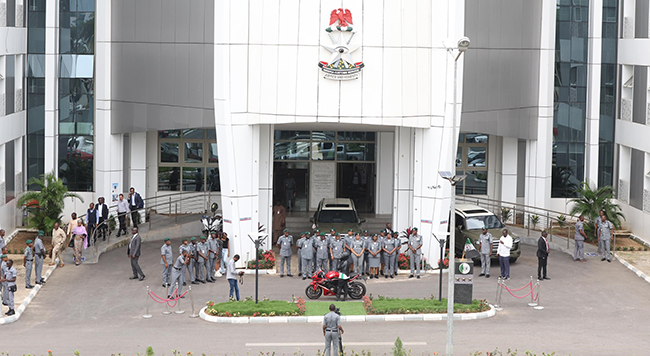
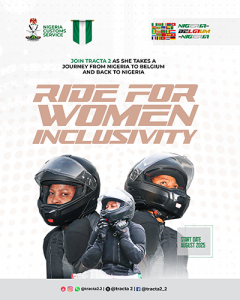 The Nigeria Customs Service supported the initiative wholeheartedly. I had presented my project to the Controller Gneral in writing, explaining its research value, and outlining safety measures. I was transparent. The Administration offered moral and financial support, and we established a monitoring and reporting system.
I then had to prepare for my journey, getting visas and contacting Customs agencies to let them know I would be passing a specific border post around a certain date and conducting a survey with officers, traders and drivers.
From Nigeria, I crossed into Benin, then into Togo, Burkina Faso, Mali, Senegal, Mauritania, Morrocco, Spain, France and finally arrived in Brussels, Belgium. On the way back, I rode through the Netherlands, Germany, Poland, Czech Republic, Austria, Liechtenstein, Switzerland, France, Spain, Morrocco, Mauritania, Senegal, Guinea Conakry, Côte d’Ivoire, Ghana, Togo, Benin and Nigeria.
The NCS headquarters monitored my progress. I provided periodic updates through daily notes, photos, videos, border incident recordings, and structured weekly summaries.
What I learned on the road
Travel humbles you. Borders teaches you. Humanity surprises you.
About myself, I learned:
- endurance is not just physical; it is mental, emotional, and spiritual;
- courage grows when purpose is clear;
- the world becomes smaller when you travel, but your heart becomes larger.
- Fear is nothing
- Positivity is everything
About borders, I learned:
- that procedures differ drastically across regions;
- that women still face disproportionate barriers;
- that language, infrastructure, and security issues shape mobility more than policy documents do;
- and that respect and communication remain the strongest tools for facilitation.
Some moments were difficult — desert crossings, fatigue, unexpected hostility, or isolation.
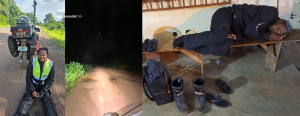
In some locations I had to wait outside on the road, with women and their children and their goods, waiting for hours to cross a border. I and fellow travellers even had to sleep outside because of delays at the border stations.
But there were beautiful moments too — officers who went out of their way to help, women traders who prayed for me, children running beside my bike, and strangers who became friends.
Extending gender equality beyond internal policy
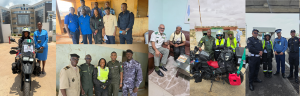
I was invited to share my experience at the WCO Gender Equality and Diversity Conference in October 2025. During my presentation, I shared my perspective that commitments to GED in Customs must extend beyond internal HR policies. They must include the trading community.
Women traders form a huge percentage of cross-border movement in Africa. Yet, I saw how they face harassment, delays, poor infrastructure, language barriers, and security risks.
If Customs truly promotes inclusivity, then its procedures must reflect empathy, fairness, and accessibility for these women and other traders.
Impact and Next Steps for NCS
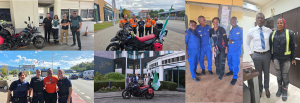
Elements of my research findings have already influenced NCS conversations, including inputs presented at the Customs Partnership for African Cooperation in Trade (C-PACT) Conference which took place in Abuja, Nigeria, in November 2025.
There are ongoing discussions within the NCS about:
- strengthening gender-responsive border procedures,
- improving traveller information systems,
- reviewing use of travel permissions like laissez-passers,
- officer training on inclusivity and communication,
- expanding inter-agency collaboration within ECOWAS,
- establishing one stop shops for Customs verifications,
- developing a unified travel system across regions in Africa to reduce repetitive checks
Where I’m headed next
The road never ends. Africa is vast. The world is bigger still. And research evolves. My next destination? Wherever there is a border worth understanding, a woman worth inspiring, or a system worth improving.