

The automated data journey
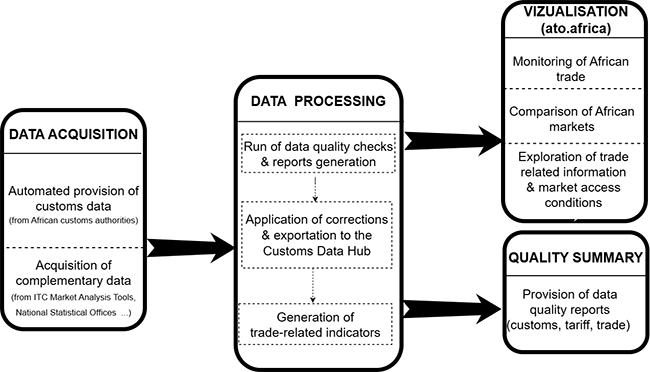
The collected Customs data feeds what is called the “African Customs Data Hub”. After the completion of data quality checks on shared data, the processed and aggregated information is published on the ATO online platform. The automated data journey is illustrated in the figure 1 below.
Data acquisition
The ATO is primarily sourced from national Customs clearance management systems (CMS). To standardize and secure the Customs data acquisition process, the ATO team provides a free, flexible, all-in-one data-sharing application built on modern open-source technologies. It can work with any CMS and its Docker containerization simplifies and secures installation, maintenance, versions upgrades and re-customization when the Customs authority migrates to a new CMS. Building on the WCO Data Model, the extracted data is converted into the ATO format before exportation.
Each Customs authority retains full control over the use of the application. Through an internal dashboard, officials can decide what data to share, when to share it, and with whom. They can also schedule or launch ad-hoc extractions, run verification checks, customize the fields to be shared before transfer, and verify transmitted data. At the time of publication, 11 countries have implemented or are implementing the data-sharing application, while 20 countries have been providing data manually, with plans to automate in the medium term.
Datasets
The first of its kind in Africa, the Hub collects transaction‑level data. The shared datasets include pertinent elements, such as declaration ID, product code, Customs office code, value, quantity, country of origin, duties, taxes and fees, preference utilization, transport costs, and timestamps (e.g. registration and clearance datetimes). These data fields allow the ATO to generate more than 20 trade‑related indicators at national, regional, and continental levels, designed for a wide range of users, from national administrations, to regional and continental organizations.
Data quality
Upon reception by the ATO, the datasets enter an industry-compliant digital pipeline specifically developed for the project’s needs. The digital pipeline transforms raw Customs data into trade-related indicators and produces data quality reports. This enables real-time data quality feedback and update of trade-related indicators.
Each shared dataset undergoes three groups of checks:
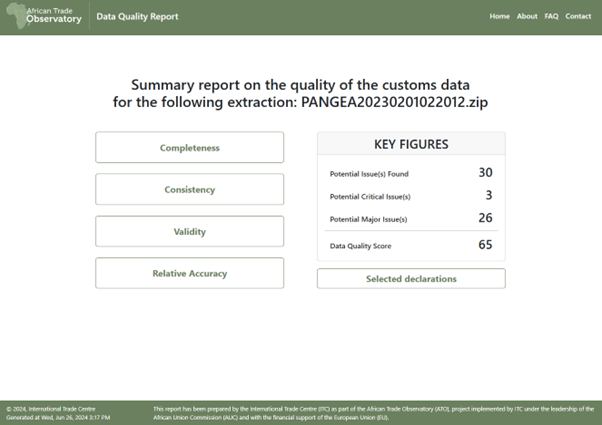
Data quality reports (see the example in Figure 2) are generated and shared with partner Customs authorities for their review, feedback, and/or action. Only datasets that meet the predefined minimum quality gates are exported to the African Customs Data Hub. Depending on the severity of anomalies, automated data corrections are then implemented when necessary.
Indicators update
Once an incoming dataset is loaded into the African Customs Data Hub, the engineering pipeline automatically updates trade‑related indicators by combining Customs data with complementary datasets. For a country such as Madagascar, the full processing cycle – from data harmonization and quality checks, to exportation to the Data Hub and indicator generation – takes around three minutes for all declarations registered and assessed during a given month.
Visualization of trade-related indicators and information on the ATO platform
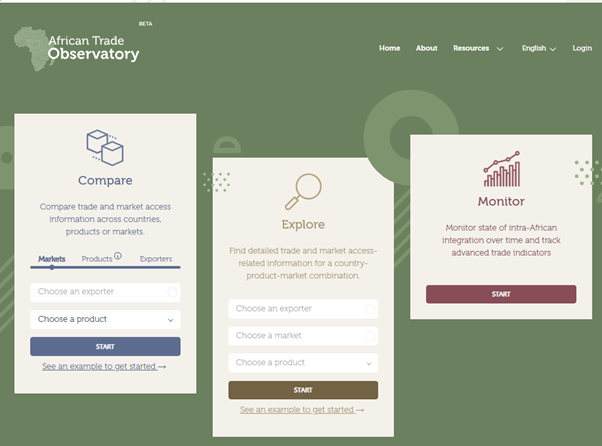
Individuals visiting the African Trade Observatory website (https://ato.africa/en) can access and visualize processed trade‑related information and indicators. The online platform (see Figure 3) is structured around three specialized modules:
Processed information that is generally publicly available – such as international trade statistics and details on applicable taxes and duties – is accessible to all. In contrast, sensitive information that is not already in the public domain – including certain trade‑related indicators (e.g. tax revenues), specific filters (such as Customs office), and data quality reports – is available only in the restricted section of the platform. Access to this area is country-specific and limited to duly authorized users.
An initiative with concrete impact for Customs
Since its inception, the ATO has provided tangible support to partner Customs authorities, particularly through enhanced monitoring of border operations and analytical assistance. Trade-related indicators based on Customs data have been made available for 26 countries. Moreover, an analysis of ATO data quality assessments indicated that, for datasets provided in 2025, potential anomalies were found in approximately 10% of records (i.e. declaration items) on average. In total, more than 35 types of data quality issues were identified. Concrete short‑term impacts have already been observed – for instance, improvements in the configuration of national Customs management systems for better reporting and risk assessment. Building on ATO support, some Customs authorities have detected non‑compliance in declarations, which has resulted in the identification of a significant amount of evaded taxes. Furthermore, actions taken following this support are going to yield results over the longer term, such as reducing the occurrence of missing values and improving dataset completeness.
The end-to-end automated ATO tool becomes even more impactful as more countries participate. Indeed, broader coverage makes the platform more comprehensive – a new country starting to share data offers the opportunity to exporting countries to analyse how frequently tariff preferences on their exports are used in that new partner country. Each new participant joining the initiative also strengthens the automated ATO tool through synergies: for instance, a quality check developed originally for one country is by default extended to all the others.
The ATO paves the way for new areas of collaboration. Participating administrations could, for example, agree to share the data they submit to the platform to conduct mirror analyses and compare export and import declarations to identify possible irregularities, such as undervaluations, incorrect classifications (tariff slippage), or false declarations of origin.
They could also decide to use the data to monitor trade flows along specific corridors, or integrate ATO data quality checks into national Customs risk‑management models. These practices would enable them to ultimately advance towards regional or continental approaches to Customs risk management, thereby further supporting the detection of non-compliance and facilitating trade across Africa.
More information
ato@intracen.org
https://ato.africa/en