Across Thailand, dangerous chemicals sat in silence
In 2022, Thailand Customs sat with more than 10,000 gas cylinders which contained banned chemicals so dangerous that, if released, they could have caused the same climate damage as over 1.1 million tons of carbon dioxide — equal to the yearly emissions of nearly 240,000 petrol cars. Thanks to a public-private partnership, those gases never reached the atmosphere. Instead, they were destroyed — safely and permanently. This is the story of how a border seizure became a blueprint for environmental cooperation.
A hidden threat in dozens of depots
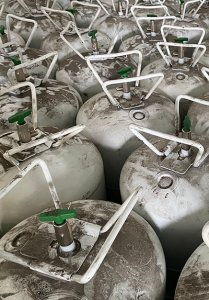 The chemicals — known as ozone-depleting substances, or ODS — were once commonly used in refrigerators, air conditioners, and fire extinguishers. Substances like Chlorofluorocarbons are thousands of times more harmful than carbon dioxide when it comes to trapping heat in the atmosphere. They also damage the ozone layer — a threat that led the global community to ban them under the Montreal Protocol on Substances that Deplete the Ozone Layer.
But that didn’t stop them from circulating. Even after the bans, ODS continued to move across borders illegally. For Thai Customs, intercepting these shipments became part of their mission to protect the environment.
Over the years, Thai Customs officers had seized and stored over 10,000 cylinders of banned refrigerants. With no law, rule or regulation requiring the destruction of ODS, the cylinders were stored in dozens of depots and warehouses throughout the country since their seizure, taking up space needed for other seized goods and slowly leaking into the atmosphere.
The Thai Department of Industrial Works (DIW), responsible for managing chemicals covered by the Montreal Protocol, did not have available funding to dispose of the cylinders using the Protocol approved destruction technologies.
A three-way partnership forms
After looking for ways to dispose of the ODS without engaging costs, the DIW turned to Tradewater.
The company beginnings germinated in the United States when the California’s cap-and-trade programme was launched in 2013. The programme aims at reducing greenhouse gas (GHG) emissions by setting a firm cap on statewide GHG emissions from major sources. Each covered entity is required to surrender one permit to emit for each ton of GHG emissions they emit. It is also able to buy additional allowances at auction, purchase allowances from others, or purchase offset credits.
Tradewater co-founder Tim Brown noted that destruction of ODS qualified as an offset project, achieving emission reductions while generating offset credits. He also realized that you could still buy these gases on eBay. He soon filled up his home basement and turned to figuring out how to safely and efficiently destroy the gases. He was soon joined by Gabe Plotkin, and Tradewater was officially born in 2016. Tim and Gabe’s mission was to tackle some of the thorniest climate issues by finding forgotten or commercially non-viable industrial super pollutant gases and converting them into carbon offset credits to fund future work.
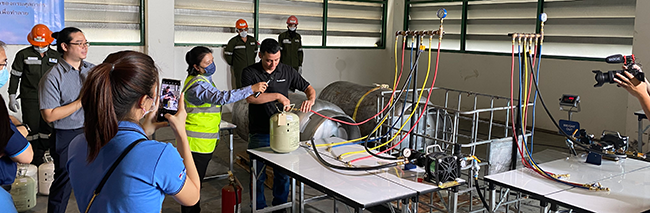
Tradewater’s decade of experience in operating with similar refrigerant destruction projects across the world provided Thai Customs with the confidence that these gases would be properly and permanently destroyed. In Thailand, Tradewater teamed up with Waste Management Siam (WMS), which operates a certified incineration facility.
Together with Thai Customs, the three organizations formalized a tripartite agreement: Thai Customs transferred ownership of the seized cylinders and their environmental attributes to Tradewater, through WMS. As the licensed destruction operator, WMS managed the on-site inventory, consolidation into ISO tanks, and environmentally safe incineration. Tradewater provided technical oversight and financed operations.
The project launched in late 2022. Over the following months, cross-functional teams visited 12 sites across the country to collect, test, and prepare the seized cylinders — more than 10,000 in total. Each one was weighed, sampled, and handled according to international safety and destruction standards.
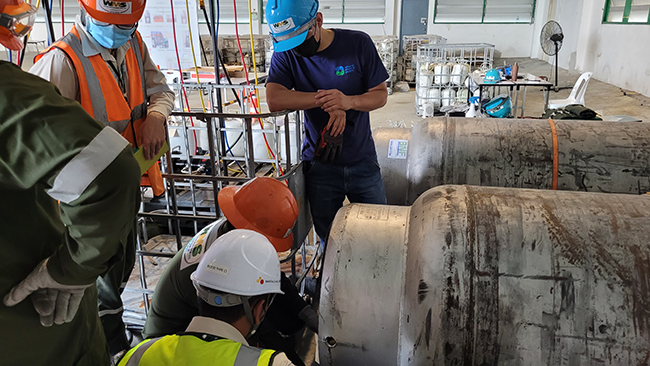
At the WMS facility, the gases were incinerated under continuous emissions monitoring, achieving over 99.99% destruction efficiency — the performance benchmark set by the Montreal Protocol.
The project’s first two phases, completed earlier this year, resulted in the destruction of more than 120,000 kilograms of high-impact refrigerants — with additional phases planned.
A Model for the World
Independent third-party verifiers confirmed that over 1.1 million metric tons of CO₂-equivalent emissions were permanently prevented — one of the largest refrigerant destruction efforts in Southeast Asia to date. Tradewater financed this work through the sale of resulting carbon offset credits on the voluntary carbon market.
The success of this effort hinged on early action by Thai Customs. Their enforcement and secure handling of the seized stockpile prevented years of potential leakage — making it possible to implement a permanent, high-impact solution.
“We commend the diligence of Thailand’s government and local stakeholders, as well as their close collaboration, in getting this critical project off the ground,” says María José Gutiérrez Murray, Senior Director of International Programs at Tradewater. “We are working to develop similar relationships with other like-minded stakeholders around the globe.”
More information
Contact the author