
Data flows and work processes
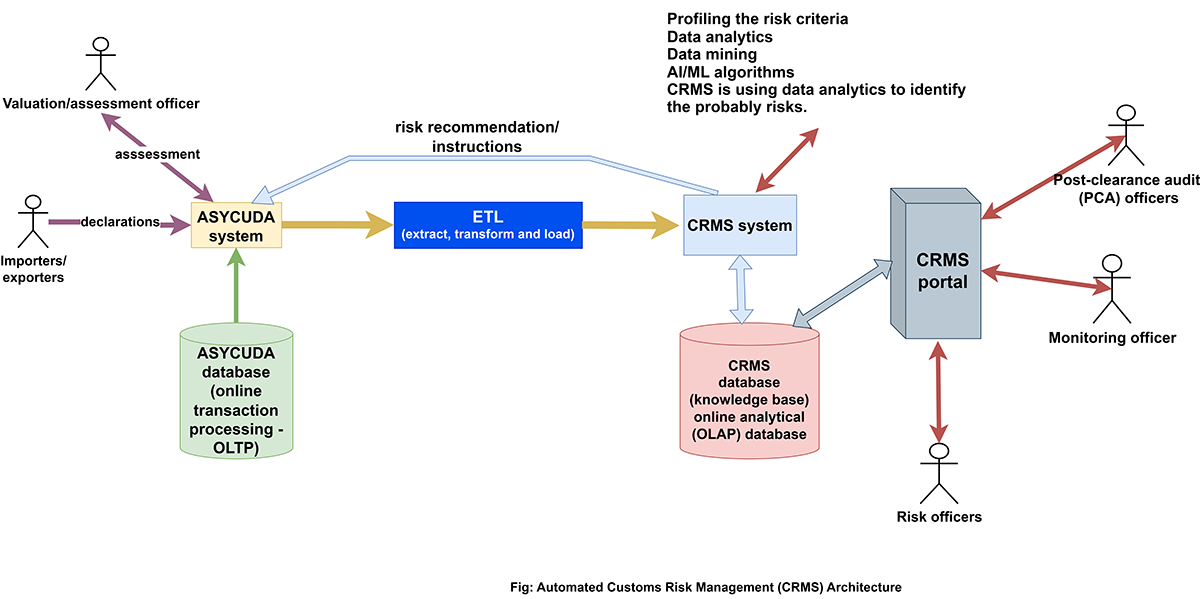
Under the current system, when declarants submit a declaration, the CRMS retrieves the declaration information in real time from the ASYCUDA system and processes the input data against these analytical models. The CRMS then generates a set of recommendations, which are classified, categorized and prioritized. These recommendations are then sent to Customs officers through ASYCUDA World for assessment. Post-clearance audit and inspection results are systematically analysed to refine and update risk parameters.
The block diagram of the CRMS system architecture is shown in the figure below:
Impact
The CRMS has been implemented in six major Customs offices which process nearly 90% of all commercial consignments. As officers became more familiar with CRMS, the system began to have a positive influence on both individual performance and organizational culture.
A declaration may appear compliant on the surface, but by systematically identifying inconsistencies in trading behaviours, for example the routing used, the CRMS supports the targeting capacity of Customs officers, especially in cases of misdeclaration and under- and over-invoicing. Analysis of declarations over three months showed an increase in the number of compliant declarations related to the importation of a specific product after shipments of such items had been targeted and practices such as declaring incorrect branding, models and sizes had been uncovered. Improvement in the quality of the data provided by declarants significantly enhanced the detection of other risks related to the said product, such as undervaluation, overvaluation and quantity fraud. The CRMS identified misclassification in 0.02% of the declarations for those shipments, enabling Nepal Customs to collect approximately 3.74% additional revenue from those items.
By automating routine risk assessment and providing clear recommendations, the system reduced cognitive workload and time pressure on front-line officers, who reported enhanced data interpretation skills, improved decision consistency and greater confidence in selectivity outcomes. Overall, the CRMS improved productivity, decision quality and job satisfaction, while fostering a culture of accountability, collaboration and continuous learning within Nepal Customs.
Way forward
Moving forward, Nepal Customs aims to expand the capabilities of the CRMS by adding images generated by non-intrusive inspection systems as a data source and applying deep learning algorithms to identify abnormal patterns, structures and rearrangements of goods in images, enabling the detection of concealed illegal items mixed with legitimate consignments. The CRMS will also be further enhanced through integration with other IT systems, such as those of Nepal Inland Revenue and oversight agencies, and through access to intelligence generated by investigations conducted by these bodies. Customs administrations interested in the CRMS, especially those using ASYCUDA, are invited to contact the author.
More information
Contact the author
www.customs.gov.np