TRS 2019: a starting point for change
As part of its commitment to implement the TFA, including Article 7(6) which provides for Members to “measure and publish their average release time”, in November 2018 Guatemala held a “National workshop on the methodology to measure the time required for the release of goods”, with technical assistance from the WCO, aimed at developing the skills and knowledge of its staff. The workshop marked the start of a systematic effort to construct a national baseline for actual release times and generate quantitative evidence to underpin institutional modernization.
In 2019, again with technical assistance from the WCO, the SAT developed its first TRS with a focus on imports, making Guatemala the first country in Central America, and the second in Latin America, to formally apply the TRS methodology. The working group comprised 12 individuals, seven of whom were SAT officials and the remainder representatives of the leading stakeholders within the importation supply chain.
The development of the TRS follows the guidelines set out in the WCO Guide and is built around four core phases. The first of these, preparation, includes the establishment of working groups, determination of scope, design methodology and engagement of key actors. The second, data collection and recording, focuses on data-gathering in real time and retrospectively, ensuring traceability and reliability. The third phase concerns data analysis and involves verifying declarations, validating records and inputting data into the official WCO software. Finally, the monitoring and evaluation phase is intended for following up findings and designing corrective measures for incorporation into national and regional plans.
The SAT designed an interinstitutional roadmap that covered the entire country geographically, focusing on four of Guatemala’s strategic Customs posts: Puerto Quetzal, Santo Tomás de Castilla, Express Aéreo and Tecún Umán II, which account for a significant share of foreign trade and the highest volume of imports handled by the country. The study focused on final imports, covering goods transported by sea, air and land, including containerized cargo and general cargo. The scope of the study enabled the Customs clearance process to be measured comprehensively in real time from the time of goods’ arrival to their release, identifying the various players in the supply chain in line with the WCO methodology.
The main objective was to establish a baseline for average release times, identify bottlenecks and formulate actions to modernize processes, regulations, infrastructure, technology and resource management.
The data-collection phase combined manual and automated methods: trained observers took down information by hand in the field, while records from SAT computer systems and temporary Customs warehouses were also trawled. In all, 13 public-sector institutions and 23 private-sector institutions took part in this phase, involving a total of 165 participants.
The duration of the measurement period was seven consecutive days simultaneously at the Customs posts covered by the study, and follow-up time was one month for samples where information from the measurement period was outstanding.
Key challenges
While developing and implementing the various phases of the study, the Guatemalan Customs Administration encountered a number of key challenges. First, taking on leadership of the process and achieving solid commitment from institutions and colleagues was difficult because of the high number of stakeholders with differing responsibilities, institutional priorities and their workloads; this challenge was addressed through the establishment of clear coordination mechanisms, the designation of institutional focal points and ongoing technical support from the WCO, which streamlined efforts and provided continuity for the study.
Secondly, the dissemination and sharing of information involved in the project was a stumbling block to full involvement on the part of the public and private sectors, especially given the need for transparency in oversight of processes and use of information; to overcome this, forums for communication and awareness-raising were established, in particular the Public-Private Roundtable on Customs Matters, where the methodology, objectives and benefits of the study were discussed, thus building confidence and promoting active, collaborative participation.
National Action Plan 2020-2023
Incorporating opportunities for improvement, as reflected in actions for the short, medium and long term, into an instrument that would commit those in charge to implementing the improvements also proved challenging. Finally, a three-year National Action Plan (PAN) was drawn up. The plan consolidated all the opportunities for improvement, allocated responsibilities and set out short-, medium- and long-term actions to modernize the import process.
For the SAT, the actions focus on:
In 2020, the COVID-19 pandemic hit the country, and Guatemala faced the complex task of implementing and monitoring actions under the PAN against a background of movement restrictions. Despite this, it succeeded in:
To ensure implementation of the actions, three technical teams were established combining the public and private sectors, logistics and Customs operators, public authorities, representatives of chambers of commerce and other stakeholders. The three teams were divided by transport mode (air, sea and land) depending on stakeholder relevance, representation and operational involvement.
Once established, the Guatemalan Customs Administration asked the teams to implement monitoring methodology that incorporated:
Impact on clearance times
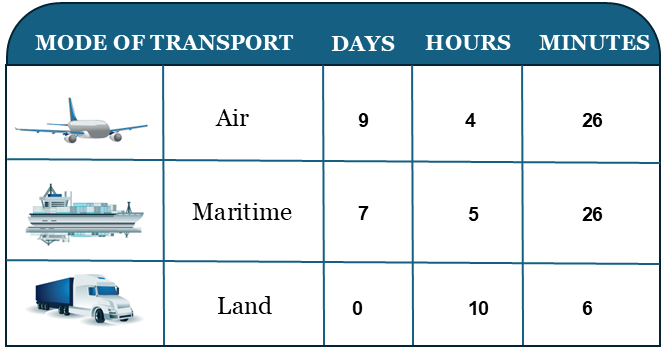
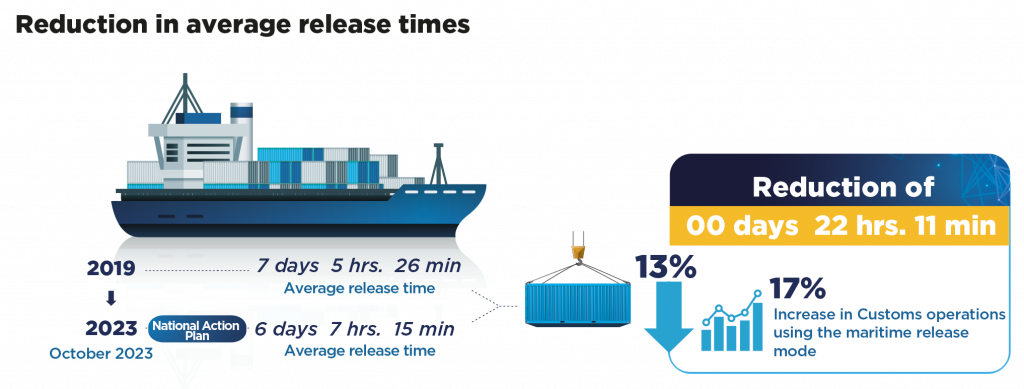
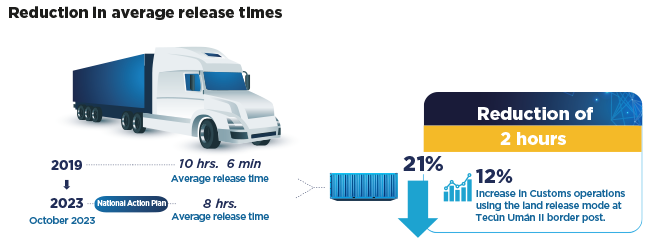
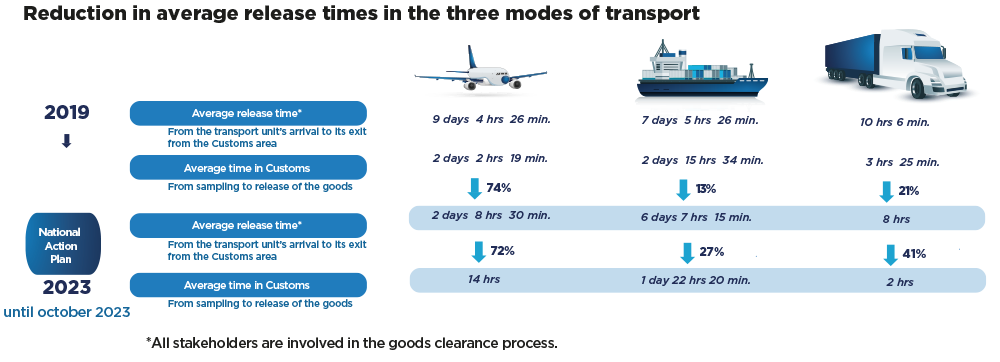
As part of the follow-up to the National Action Plan 2020-2023, KPIs and other strategic indicators were measured in 2023 and, for the first time, included an evaluation of the release time based on data extracted directly from institutional IT systems. The exercise produced objective information and showed significant outcomes in terms of operational efficiency and trade facilitation, confirming the positive impact of the actions taken under the PAN.
Air mode:
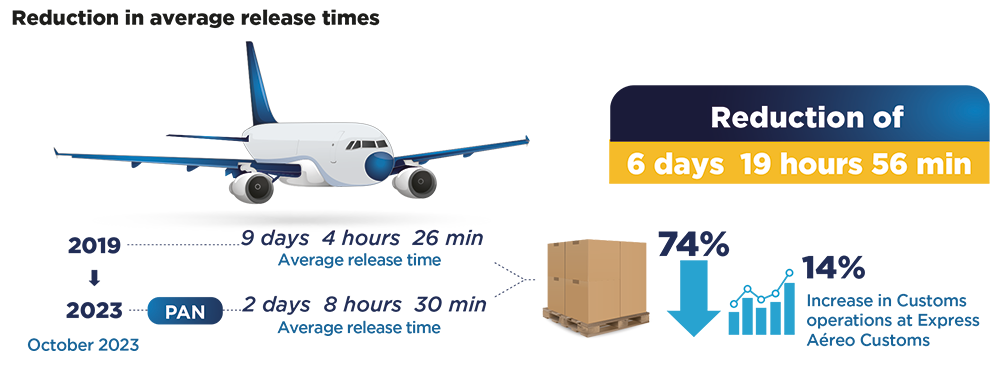
Maritime mode:
Land mode:
Overall, the average clearance times for import procedures were significantly reduced for all three modes, increasing Guatemala’s logistical competitiveness and establishing the country as the regional benchmark in this regard.
Regional TRS 2021: a world first
In 2021, Guatemala, in its capacity as WCO Regional Vice-Chair for the Americas and the Caribbean Region and holder of the Pro Tempore Presidency of the Central American Customs Committee, led the world’s first Regional Time Release Study. This historic project brought together:
Guatemala is the only country in the region with prior experience in developing Time Release Studies in line with the WCO methodology. Guatemala provided technical leadership, mainly in the following areas: transfer of technical capacity – supporting national teams and helping them to understand and implement the TRS methodology; interinstitutional coordination – sharing good practice in respect of both coordination between Customs authorities and standardization of methodology – in so doing, it helped to identify common criteria for data collection, validation and analysis; and the drawing up of national and regional reports – supplying technical guidelines that made for consistent, comparable, good-quality outcomes.
Given that not all countries had prior experience in this type of study, capacity building became a cross-cutting theme of the regional TRS. A scheme of work to build technical capacity gradually was implemented that included regional workshops, virtual training and specialist support. This was supplemented by mechanisms for cooperation between pairs of countries that facilitated hands-on learning for national teams and helped them take ownership of the methodology.
For regions interested in developing a regional TRS, it is vital to build on existing skills, draw up a harmonized methodology, strengthen technical groups through peer-to-peer cooperation and provide the institutional backing necessary to translate the outcomes into specific improvements.
The study evaluated processes and times in the 13 leading border posts in the Pacific corridor.
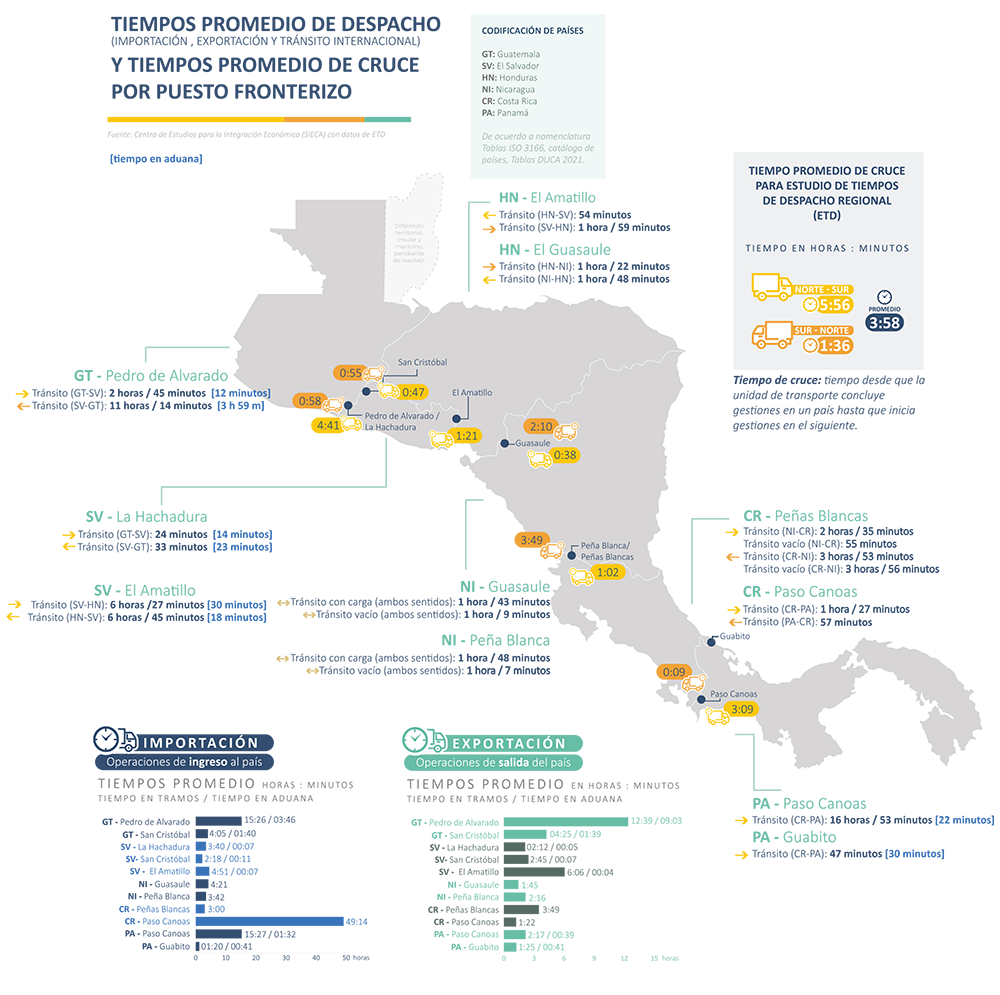
The scope of the study was to measure and analyse Customs procedures at the Customs posts on the region’s Pacific Corridor for land mode transport, looking at import, export and transit operations for general and containerized cargo.
The fact that this was a regional TRS raised a number of challenges, including disparities in technical and institutional capacities, the availability of information and the complex nature of the interinstitutional coordination required; these challenges were overcome by using harmonized methodology, capacity-building through training and technical support provided by experts from Guatemala and the WCO, the exchange of good practice between countries and the establishment of regional co-ordination mechanisms that made for comparable outcomes and consistent analysis.
The process resulted in a Regional Action Plan listing actions by country alongside bilateral actions to improve times for importation, exportation, transit and border crossing.
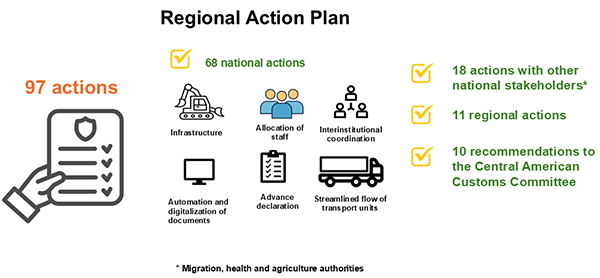
The countries in the region adopted national plans based on the regional study and are achieving measureable progress as a result of their actions:
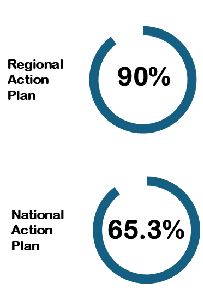 Progress made in digitalization and improvements to infrastructure at border posts on the Pacific Corridor in the first edition of the TRS.
Road to the second edition of the regional TRS
Thanks to the success of the 2021 study, the Guatemalan Customs Administration and SIECA are planning a second edition of the regional study incorporating:
Export-focused TRS in 2025 and the National Action Plan 2026-2029
In 2025, Guatemala developed a second national study, this time focusing on export operations; it was conducted at its three main ports.
The second edition of the Time Release Study was significantly broader in scope: it included conducting a comprehensive analysis of the maritime foreign trade supply chain focusing exclusively on the exportation of containerized cargo. The study incorporated the country’s leading port terminals – Puerto Barrios, Santo Tomás de Castilla, Puerto Quetzal and the Specialized Container Port Terminal (TPEC), enabling a representative evaluation to be made of the logistical and operational performance of the Guatemalan export chain. The study is based on the updated TRS methodology of the WCO, which measures times and procedures in standardized fashion from a container’s entry into the port terminal until its release for export. This makes it possible to identify bottlenecks, institutional efficiencies and areas where there is room to achieve greater trade facilitation and boost Guatemala’s competitiveness on international markets.
The results show substantial differences between the port terminals. On average, export times vary between 2 and 5 days: Santo Tomás de Castilla is the fastest at 2 days and 5 hours, and Puerto Quetzal is the slowest at 5 days and 18 hours. The latter is down to the absence of an operational cut-off, which means that containers may remain in port as a result of a decision by the exporter, with no established time limit. This finding highlights the importance of harmonizing operational criteria across terminals in order to ensure standardized conditions and greater logistical efficiency.
December 2025 saw the publication of the Report on the Outcome of the Export TRS and the National Action Plan 2026-2029, which will act as a guide to export modernization. The plan consists of 48 strategic actions linked to 18 stakeholders that are part of the maritime exportation process. Over half the actions will be implemented in the short term, demonstrating a direct focus on outcomes.
In line with the standard established since 2019, the plan included:
Plan for new studies in 2026
For 2026, Guatemala is preparing a new study, this time focused on bulk cargo operations. This will extend the scope of studies to new supply chains that have high economic impact.
Guatemala’s contribution to Version 4 of the WCO TRS Guide (2025)
WCO Time Release Study Guide, Version 4, 2025, incorporates advanced elements of process-based management, continuous improvement, interinstitutional governance and indicator standardization.
This new version acknowledges Guatemala as an example of effective implementation of the methodology and includes a number of the practices developed in the country since 2019.
Guatemala’s contributions in Version 4 of the Guide include:
Conclusions
Time Release Studies have not only made it possible to identify opportunities for improvement, they have transformed the way in which Guatemala designs, monitors and evaluates Customs modernization, positioning it as a reliable, competitive partner that complies with the international standards on trade facilitation and security.
Further information
The studies are available at the following web address:
https://portal.sat.gob.gt/portal/estudio-de-tiempos-de-despacho/