
The ABCs of AI integration in NII
Indian Customs started working in this field in 2022, with a team combining risk analysts and developers established at the National Customs Targeting Centre (NCTC) to design a centralized, automated, dynamic and vendor-agnostic image analytics solution. By leveraging advanced AI algorithms, the solution swiftly analyses X-ray images to identify anomalies and suspicious items with accuracy.
Certain guiding steps towards AI integration in NII have been identified. The first step is to identify the Customs administration’s operational priorities, for example detecting cases of misdeclaration, uncovering concealment or identifying restricted items or a specific object or threat.
The next stage is a comprehensive assessment of the existing technology stack in terms of both software and hardware. Technological upgrades may be needed, and missing links between various nodal points for the transmission of data may be identified.
This is followed by extensive research to understand the various artificial intelligence models that cater to the objective and could be integrated into the NII systems in use. For example, a heterogeneity detection model suggests whether the image is homogeneous or otherwise based on the description of the goods declared; an object detection model identifies and pinpoints the location of an object in the container; and a container weight prediction model suggests possible weight variances based on the density of the goods declared.
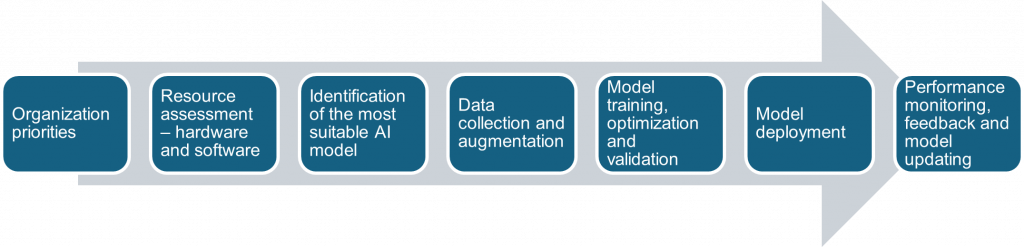
Once a suitable model has been identified, the next two crucial steps are data collection and data augmentation. Data collection involves gathering a number of X-ray images of objects of interest. The images have defined identifiable traits based on shape, texture, colour or density. The data augmentation process involves enhancing the quality of images through the use of image correction tools and labelling. Labelling of the objects in the training images is a critical stage, as it directly affects the predictive accuracy of the model.
Finding images of some objects of interest is challenging. Techniques of synthetic data generation can be used to resolve this issue, especially the threat image, a software program that inserts fictional (but realistic) images of actual threat items into the images of real items being screened using X-ray systems.
The standardization of image formats is crucial to ensure inter-operability, the integration of systems across borders and the uniformity of training material for AI models. A significant global development in this context has been the WCO’s UFF 2.0, which provides a standardized, non-proprietary data format designed for images and data generated by high-energy scanners.
Robust data collection and augmentation pave the way for model training, optimization and validation. Optimization algorithms help neural networks learn faster and converge better. By using advanced optimizers such as the Adam optimizer, adjusting network depths and using ensemble networks, the efficacy of training can be improved and peak performance achieved.
Once the model is adequately trained and tested for its operational parameters, it can be deployed along with a comprehensive support system. The human-in-the-loop factor, in this case the field image analysts, plays a central role in performance monitoring and feedback mechanisms. The AI model deployed needs periodic performance evaluation, updates and training to maintain optimum output. Further, with the introduction of reinforcement techniques, a self-adaptive feature can also be deployed within the AI model to integrate a real-time feedback loop along with observable self-adapting parameters.
The deployment of such models also requires regular updates and the creation of libraries. As the scope of the NII widens in terms of identifying newer classes of objects, there is an immediate need to update the training of the model and measure its performance in the light of new additions.
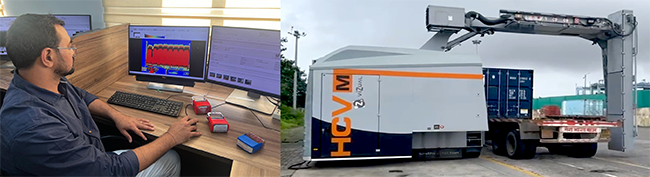 India’s AI-driven NII architecture
The integration of AI-enabled NII opens a wide spectrum of capabilities and functionalities with respect to its practical application. Each model has its unique traits and characteristics, which are defined by the Customs administration’s goals. Depending on the capacity of the scanners and total trade flows, a Customs administration needs to decide whether scanning all cargo is necessary or if a risk layer is required to select only high-risk cargo.
India employs a risk-based selection of cargo according to which only selected consignments are marked for scanning. The NCTC develops risk-based selectivity parameters in a centralized manner for cargo scanning.[1]
By leveraging advanced AI algorithms, the X-ray image analytics solution is designed to analyse X-ray images swiftly and automate the process of detecting contraband, concealment and cargo misdeclaration within images. This AI solution has been fully developed in-house to address the risks specific to the Indian context most effectively. Open-source AI models for product classification, heterogeneity detection, object detection and container weight prediction are trained to provide automated risk insights based on images.
The product classification model analyses the image, identifies the products and proposes various options for their classification within the Indian nomenclature of goods. The object detection model goes a step beyond the product classification model, not only identifying the objects in the container but also accurately pinpointing their exact locations. For this, an open-source deep learning algorithm such as YOLOv7, known for its real-time processing capabilities and high accuracy in identifying and locating objects within containerized cargo, is used. The model supports an expanding set of object classes, enabling continuous enhancement of detection capabilities.
Challenges and collective solutions
The major challenges faced during the development, integration and deployment of such models include the non-availability of data, the cost of the technology stack, alignment of the models with existing systems for compatibility of input and output, and the training of both the models and personnel.
Indian Customs addressed these challenges through effective collaboration. Different verticals under the Central Board of Indirect Taxes and Customs, such as the National Customs Targeting Centre, the Directorate General of Systems and Data Management, the Department of Logistics and technical vendors, were at the helm of developing the models and providing the data required for training them. This approach helped compartmentalize the challenges and allowed for efficient and rapid resolution. One current area of work is the deployment of the UFF on NII equipment, as for the time being, the images generated by the container scanning systems are shared and processed in other formats.
Utmost importance is also given to regular interactions with field officers regarding feedback and performance measurement of the models as it helps instill confidence among them while simultaneously improving model performance.
Reimagining cargo security
The integration of artificial intelligence into non-intrusive inspection systems represents a significant advancement in Customs risk management. Officers analyse the images based on their own expertise, while simultaneously receiving the results of the AI-based models. They then decide whether the image is “suspicious” or “not suspicious”.
KPIs show that detection accuracy has been enhanced. The higher hit rate, measured as the proportion of AI model predictions leading to the discovery of irregularities, has not only helped tackle smuggling at borders but also optimized operational efficiency of Customs officers, reduced dwell time and improved risk-based targeting. Notable detections across seaports in India include firecrackers in consignments declared as miscellaneous items, cosmetics found among garments, and cigarettes concealed in cargo declared to contain air fresheners.
As technology evolves, continuous refinement, adaptive learning and strategic investments are pivotal in realizing the full potential of AI-driven NII systems. Indian Customs remains committed to sharing its experience with other Customs authorities and welcomes further engagement with interested administrations.
More information
hrishikesh.utpat@gov.in
shivam.dhamanikar@gov.in
sruti.vijayakumar@gov.in
[1] https://www.cii.in/International_ResearchPDF/Trade%20Facilitation%20Report_June%202023.pdf