

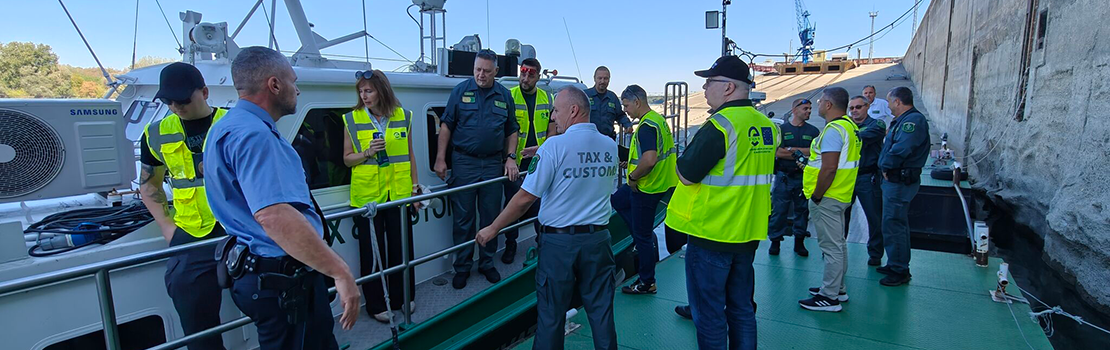
A layered architecture ensures that the expert team is familiar with the operational challenges related to different types of border environments, while at the same time keeping a broader picture in mind. One layer consists of six working units, supported by thirteen expert networks. The units and the networks meet regularly, both in person and virtually.
Of the six units, four are operational and specialized in specific control environments.
The four operational units are supported by two horizontal units.
Thirteen thematic networks bringing together more than 400 Customs officers
Also formed by national experts appointed by the EU Member States’ Customs administrations, EUCAB’s 13 thematic networks extend EU Member States’ participation, strengthen horizontal collaboration and enhance topic-specific expertise. Overall, more than 400 Customs officers have already been involved in this voluntary platform for peer-to-peer cooperation.
These communities of professionals united by shared goals cover the following priority operational fields and strategic support areas:
“I view EUCAB as a much-needed, even essential, initiative for cooperation between airports and postal hubs. It is an irreplaceable element that facilitates the exchange of information across a wide range of areas, connects us across Europe, and highlights examples of best practices as well as shortcomings.” Igor Soós, Director of Customs Office Prague Ruzyne, Czech Republic
Turning coordination into structured and sustainable capability building
While EUCAB’s work is structured by an Implementation Plan, a ‘test, learn and adapt’ method helps maximize its impacts and added value. What can be improved? What can be done differently and better? What more can be done thanks to this voluntary cooperation engine?
EUCAB’s main activities include work in the following areas.
Each operational unit takes the lead in defining specific knowledge and skills requirements and identifying capability gaps and corresponding training needs, while also taking into consideration evolving or emerging operational challenges. If the training needs are not covered by the courses available on the European Commission’s Customs, Tax & CBAM EU Learning Portal, expertise is pooled to develop new curricula to be integrated into national training systems, thus avoiding duplication. The training network ensures methodological consistency and provides support for the development, coordination and delivery of training solutions that can benefit EU Member States sharing similar operational backgrounds. Specialized training priorities have been identified in vessel or aircraft rummage, container searches, the detection of false container seals, and intelligence-led and risk-based Customs controls.
EUCAB also aims to identify gaps in equipment, accelerate the dissemination of successful technical solutions, and constantly monitor and assess emerging technological innovations in a close dialogue with Customs officers using equipment in different Customs control environments. Operationalization is the key word: beyond procurement, it is important to provide mutual support in testing and integrating innovative equipment into control systems, thus improving their coherence and interoperability, monitoring the evolution of work methods, and sharing feedback within the community of operational users (canine/detector dog experts, X-ray operators, image interpretation specialists, artificial intelligence (AI) solutions experts, and drone specialists, among others).
EUCAB’s expert team has identified significant differences regarding organizational structures, access to operational information and use of digital tools among Customs administrations. It therefore aims to strengthen operational cooperation between risk experts by promoting common operational approaches and improving the collective understanding of risk trends affecting different kinds of European borders. In an advisory approach, it helps achieve common definitions in the area of risk management and disseminate analytical resources, providing practical guidance on good practices and related training needs.
Whatever the priority, EUCAB does not replace national policies or the EU’s legislative and strategic work. Rather, it acts as an amplifier of EU Member States’ expertise and a facilitator for swift and impactful dissemination of good practices.
“EUCAB’s positioning offers national Customs administrations a valuable asset: to be able to rely on solutions that have already been tried and tested or are being developed elsewhere in Europe. A way of avoiding exploratory approaches that are costly in terms of time and resources, while limiting the risk of adopting systems that are less efficient or disconnected from existing standards.” Michael Lachaux, Regional Director of Customs in Marseille, France
From conducting diagnostics, to offering services and supporting implementation
All operational units have developed a similar subsidiary method building on EUCAB’s unique strengths and added value. This starts with the assessment of a topic, based on surveys to map national initiatives, reviews of existing resources, and peer-to-peer expert exchanges within networks, in order to establish a gap analysis at the EU level and a plan for action.
The process continues with the elaboration of a tailored offer of services promoting opportunities for strengthening operational performance, in the shape of frameworks, methodology, and maturity models geared towards the needs in the field.
Implementation is key. Each roadmap for common and continuous improvement considers challenges to adopting the proposals, designing step-by-step adoption processes and paying attention to user-experience and follow-up. This improves capacity in the field, and the collective knowledge is consolidated in deliverables such as evidence-based databases or reports on best practices.
“Member States can learn from pilot projects, avoid repeating mistakes, and build on proven solutions. This exchange of best practices helps ensure that innovation is not theoretical, but directly applicable in daily Customs operations.” Maarten Veltman, Chair of the Innovation Coordination Group (CGI) at the Dutch Customs Administration
Tool focus: diagnostics
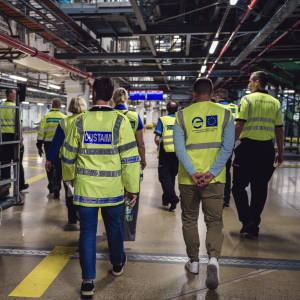
EUCAB has developed a distinctive operational diagnostic framework for each control environment in order to provide a thorough understanding of operational strengths, vulnerabilities and development needs.
“Acting as one” without artificially standardizing working methods, but leaving enough space for constraints to be taken into account, is one of the challenges of multilateral operational cooperation.
Diagnostic reviews are requested by EU Member States on a voluntary basis: the assessment is performed in close cooperation with the relevant national and local Customs offices responsible for operations. This approach creates an atmosphere of trust, allowing open discussions, a comprehensive overview of operational challenges, and realistic recommendations for improvement. Its purpose is to provide confidential operational advice based on the collective experience of European Customs administrations.
A structured questionnaire covers all key aspects of Customs operations. The questionnaire or framework is applied consistently during on-site visits. It is constantly adapted to reflect emerging threats, new techniques and evolving control practices. It is intended to be developed into a self-assessment tool.
A supporting site visit helps directly evaluate the data collected in the diagnostic tool. In the spirit of EUCAB’s mission, the visits allow for the sharing of experience and operational evidence firsthand.
After every diagnostic visit (port reviews, visits to airports and postal hubs, road and rail BCP diagnostic visits), a final report is provided to the Customs authority; this provides confidential recommendations based on EU good practices.
As of October 2026, there have been:
In addition to confidential diagnostic reports, EUCAB is keen to share, in an anonymized way, recurring challenges and capability development needs in various EU Member States, as well as a catalogue of good practices, findings and recommendations.
“A central contribution of the project is the systematic exchange of knowledge. Although Member States face similar problems and challenges, our responses often differ. The project also supports the creation of best minimum standards in different areas.” Col. Vladimír Pisár, former Director General of the Customs Section, Financial Directorate of the Slovak Republic
The challenges of a cooperation infrastructure grounded in the field
Should capacity building be favoured or resilience? Should the focus be on the exchange of officers or cooperation with third parties? E-commerce management or training?
For EUCAB to represent a real added-value, listening to what is needed and having the agility to respond are key. But the challenges that the EU’s 27 Customs administrations have to deal with are numerous and ever-changing, and cannot be covered by EUCAB alone within a limited time span. The diversity of Customs administrations is a strength, but can also be a challenge. This requires a subtle exercise of aligning directions and priorities with EUCAB’s mandate, strengths and available resources.
EUCAB is about prioritizing objectives and adjusting goals to needs, in accordance with EU Member States’ expectations and the Commissions’ overall goal of the Customs Union reform which was agreed in March 2026 (see WCO News 110).
Laying the groundwork for EUCA
At the head of the EU Customs reform stands the new European Union Customs Authority (EUCA), whose core task will be to manage the European Union Customs Data Hub, a centralized platform that will collect, process, connect and store all relevant Customs data at EU-level in one central platform, instead of in the current 111 separated national systems in the EU’s 27 Member States.
By design, EUCAB is also adjusting its objectives and activities to accompany the creation of EUCA, thus focusing the experts’ efforts on the most relevant topics and the most significant contributions, where its added value is unmatched, to accompany EU Member States in the context of the wider transformation of the European Union’ Customs landscape led by EU bodies.
As Martin Reuter, Head of EUCAB, puts it, “the success of the EU Customs reform does not depend solely on the legislative framework, but also on the capacity of each Member State to implement it coherently and collaboratively. Working towards this goal, particularly before EUCA steps in, EUCAB acts as an essential “bridging force” within the EU Customs community, a strategic asset that guarantees cooperation among EU Customs administrations to face common challenges at the EU external borders”.
Stronger together: EUCAB as a source of inspiration
Some key takeaways from the lessons learned by EUCAB are:
More information
Follow EUCAB on LinkedIn or go to the dedicated website.