


PREPARED BEFORE THE STORM
Jamaica recognises that its geographical position and exposure to hurricanes, floods and other natural hazards make disaster preparedness a national priority. The country’s disaster-management framework is led by the Office of Disaster Preparedness and Emergency Management (ODPEM). The framework brings together public-sector agencies, private-sector operators and humanitarian organizations at national, regional, parish and community levels.
Within this system, Jamaica Customs has a clearly defined role. The JCA is a member of the National Disaster Risk Management Council and participates in the Humanitarian Assistance Committee and the Port Relief Clearance Working Group, and once activated, provides overarching coordination for relief clearance at ports of entry.
A FRAMEWORK GROUNDED IN INTERNATIONAL STANDARDS
Jamaica’s approach also reflects internationally recognised Customs principles.
Jamaica acceded to the WCO Revised International Convention on the Simplification and Harmonization of Customs Procedures (RKC) in 2021, including Specific Annex J which includes a specific chapter on relief consignments. The Convention provides a clear international benchmark for disaster-related Customs procedures and also recommends that qualifying relief consignments received by approved organisations be admitted free of import duties and taxes. The WCO emphasises that Customs should facilitate the rapid and legitimate movement of humanitarian assistance while maintaining the controls necessary for safety, security and compliance. The Jamaican model reflects that balance. Relief does not mean the border becomes uncontrolled. Rather, controls must become smarter, more targeted and proportionate to the emergency.
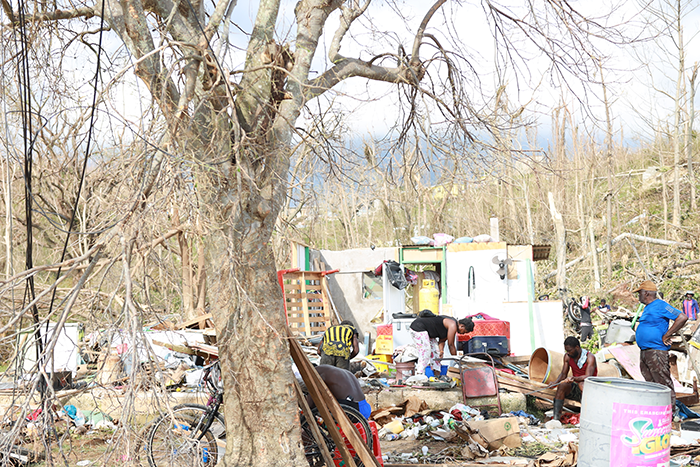
FROM PREPAREDNESS TO ACTION
Following Melissa, the Government approved relief from Import Duty and General Consumption Tax (GCT) on specified humanitarian and recovery-related imports.
The initial measure took effect from 29 October 2025 and covered both ODPEM-coordinated relief consignments and qualifying supplies imported by individuals and institutions.
For ODPEM-coordinated imports, certification by ODPEM allowed qualifying relief consignments to receive the statutory exemption. For donations to individuals, community groups and other entities, the JCA established an indicative list of qualifying items and applied eligibility requirements designed to distinguish genuine relief supplies from ordinary commercial imports.
The JCA also translated the emergency fiscal policy into its electronic Customs environment by creating Additional National Code CH9 for qualifying Hurricane Melissa relief imports. This was a practical innovation: the relief measure was not left as a policy announcement but was embedded directly into the clearance process, allowing officers to identify shipments declared as relief goods and apply the approved treatment efficiently.
The list of eligible items included essentials such as food, hygiene products, first-aid supplies, building materials, tents, generators, lighting equipment, and basic tools. As recovery needs became clearer, the list was expanded. The Government also approved duty and GCT relief for communications and energy-related equipment, including Starlink equipment, recognizing that restoring communications and electricity was essential to recovery.
The relief period had to evolve. Initially established for 30 days, it was extended to 31 December 2025. At the end of December, the Government extended the deadline again to 15 January 2026 after recognising that the Christmas period had placed significant pressure on shippers, freight forwarders, brokers and ports. The extension ensured that consignments already moving through disrupted logistics chains were not unnecessarily excluded from relief. This was an important lesson in crisis administration: a good emergency policy must be capable of responding to conditions on the ground.
ADJUSTMENT TO STANDARD OPERATING PROCEDURES
The scale of the disruption meant that established operational procedures had to be adjusted.
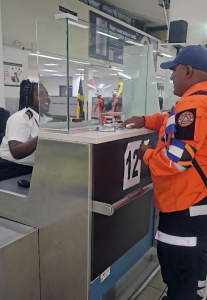
The JCA maintained priority processing for relief cargo and officers worked extended shifts, including weekends and public holidays, to prevent humanitarian consignments from becoming another casualty of disrupted logistics.
The Agency also had to operate in an environment where infrastructure itself had been compromised. Damage to Montego Bay and other western logistics infrastructure created pressure on available gateways. Alternative clearance arrangements, including the use of facilities such as Reynolds Pier in St Ann, on the Northern part of the country, helped provide additional capacity when normal routes were constrained.
The operational challenge was not simply volume. It was complexity. Relief shipments arrived through multiple channels, from government agencies and established charities to private individuals, churches, community organisations and members of the Jamaican diaspora. Some were containerised shipments; others consisted of barrels, boxes and smaller consignments.
The JCA responded by publishing practical guidance, explaining documentation requirements and the distinction between relief and ordinary imports. Donors were encouraged to coordinate through ODPEM or appropriate registered organisations, while the Agency also established a dedicated email channel for relief-clearance enquiries: emergencyreliefclearance@jca.gov.jm.
COMMUNICATING IN A CRISIS
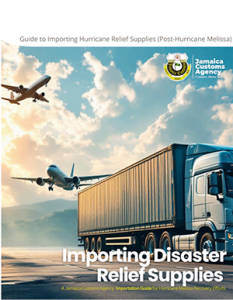 Before the hurricane, the JCA used its website, social-media platforms and traditional media to advise stakeholders about office closures and operational changes. After the storm, communication shifted towards explaining relief eligibility, documentation, deadlines and changes to the relief programme. The Agency also published a dedicated relief-importation guide and list of eligible items.
As the relief period was extended, the Agency repeatedly updated the public. This reduced uncertainty for donors and freight operators and helped ensure that policy changes were understood before consignments reached the border.
One particularly significant adaptation came later in the response. The Ministry of Health and Wellness temporarily waived import permit requirements for a range of medical and personal-care items, including over-the-counter medication, disinfectants, first-aid kits and water-purification tablets. The JCA reported that removing this additional procedural requirement reduced processing times for relief shipments.
Here, the lesson extends beyond Customs: border efficiency during a disaster depends on the ability of all regulatory agencies to identify which requirements can safely be simplified, suspended or handled through alternative controls.
COOPERATION WITH GOVERNMENT AGENCIES
The Melissa response illustrated the value of coordinated border management.
ODPEM played a central role in identifying and certifying official relief consignments. The Ministry of Finance and the Public Service provided the fiscal policy that enabled duty and GCT relief. Health authorities addressed regulatory requirements for medical and personal-care products. Port and airport operators supported the movement of cargo and passengers. Immigration, agriculture and other regulatory agencies remained part of the wider border-control environment.
This network prevented Customs from becoming an isolated checkpoint in an emergency supply chain. It also enabled the principle of “one response, multiple mandates”: each agency retained its legal responsibilities while coordinating to prevent unnecessary duplication and delay.
The regional humanitarian logistics system reinforced this approach. CDEMA and humanitarian logistics partners supported national coordination, while updated Customs information was shared with relief and logistics organisations.
COOPERATION WITH THE PRIVATE SECTOR
Private Sector support was crucial. Shipping lines, freight forwarders, Customs brokers, port operators, airlines, courier companies and charitable organisations all formed part of the relief supply chain. Their ability to provide advance information, organize documentation, consolidate cargo and move shipments was essential to the success of Customs facilitation.
The experience also reinforced the importance of communicating with the private sector before cargo reaches the border. Guidance on eligible goods, documentation and relief procedures allowed brokers and logistics companies to prepare consignments more effectively and avoid the import of mixed consignments containing both tax exempted relief goods and other goods.
The Private Sector Organisation of Jamaica, an umbrella organisation bringing together diverse businesses and associations, and individual business partners supported the national response through their own emergency coordination mechanisms and by helping channel assistance through official government systems.
This cooperation became especially important as the relief operation collided with the traditional Christmas peak. Increased shipping volumes placed additional pressure on ports and logistics providers. The eventual extension of the tax -relief deadline to 15 January was therefore not simply a fiscal decision; it was a recognition of the realities facing the entire supply chain.

COOPERATION BEYOND JAMAICA’S BORDERS
Melissa demonstrated that disaster-relief is inherently international.
Much of the assistance originated overseas, including from the Jamaican diaspora, foreign governments, international organisations, humanitarian agencies and private donors. The JCA therefore had to operate within a wider network in which information about Jamaican requirements needed to reach actors well before shipments departed their countries of origin.
The WCO’s standards provided the international policy foundation, while regional mechanisms involving CDEMA and humanitarian logistics partners helped connect Jamaica’s national response to the wider Caribbean emergency-management system. The WCO itself identifies cooperation and information-sharing among Customs administrations and other border authorities as central to effective disaster relief.
The Melissa experience also reinforces an important point for future Customs-to-Customs cooperation: administrations in the Caribbean region need common expectations and communication channels before disaster strikes. The RKC provides that “clearance of relief consignments for export, transit, temporary admission and import shall be carried out as a matter of priority”. Where one Caribbean country is affected, neighbouring countries may become points of departure for relief cargo or transit points, and technical support or specialised assistance. For Jamaica, strengthening these Customs-to-Customs relationships remains an opportunity arising from the Melissa experience.
PROTECTING THE INTEGRITY OF THE RELIEF EFFORT
Speed could not come at the expense of integrity.
The enormous public response created opportunities not only for genuine assistance but also for fraud and misuse. Fake donation websites emerged, while Customs had to distinguish legitimate humanitarian imports from commercial cargo seeking to take advantage of relief concessions.
The use of ODPEM certification, approved item lists, documentation requirements and the Commissioner of Customs’ authority to determine eligibility provided important safeguards. These controls allowed the JCA to accelerate legitimate relief without creating an open-ended exemption that could undermine revenue, public safety or border security.
Public communication was also part of the protection strategy. Authorities encouraged donors to use official government channels and verify websites before making contributions.
This balance is central to modern disaster-relief Customs: facilitation and enforcement are not competing objectives. Properly designed risk management allows Customs to facilitate low-risk humanitarian cargo while directing attention to consignments requiring greater scrutiny.
CARING FOR THE PEOPLE BEHIND THE RESPONSE
The humanitarian dimension of the Melissa response extended to the JCA’s own workforce.
Customs officers were not observers of the disaster. Many were themselves affected. Some had homes or family members in severely impacted communities, yet continued reporting for duty at airports, seaports and other operational locations.
They processed aircraft and vessels, passengers, declarations and relief cargo while dealing with the uncertainty and personal disruption created by the hurricane.
This human dimension matters in assessing institutional resilience. Business continuity is ultimately dependent on people being able and willing to continue working during a crisis.
The Agency therefore also mobilised support for affected employees. On 14 November 2025, it launched the first phase of its One Customs Humanitarian Campaign, inviting staff to contribute cash, goods and time to colleagues and their families in the western region. In just two hours, the telethon raised more than JMD 1 million in cash and more than 600 in-kind donations, including food, beverages, toiletries, building materials and other essentials.
The initiative reflected an important principle: an organisation cannot ask its people to sustain national resilience while overlooking their own welfare.

FUTURE LESSONS
For the JCA, several lessons stand out.
First, preparedness must precede the emergency. The National Emergency Relief Clearance Plan, Business Continuity Plan and established inter-agency relationships gave Customs a foundation from which to act immediately.
Second, international standards provide a valuable starting point, but national procedures must be operationalised. The RKC principles became meaningful because Jamaica translated them into national procedures, emergency fiscal measures, electronic Customs codes and practical guidance.
Third, digital and physical flexibility are equally important. CH9 demonstrated the value of adapting Customs systems quickly, while alternative clearance facilities demonstrated the importance of having physical options when normal infrastructure is compromised.
Fourth, communication is part of clearance. Clear information to donors, brokers, shippers and the public can prevent errors before they reach the border.
Fifth, risk management becomes even more important during a crisis. The objective is not to eliminate controls but to apply them intelligently so that humanitarian cargo moves rapidly while security and regulatory obligations remain intact.
Finally, partnerships are a form of resilience. Government agencies, private-sector operators, humanitarian organisations, regional bodies, international partners and Customs administrations all form part of the same humanitarian supply chain.
CUSTOMS AS A HUMANITARIAN ENABLER
Hurricane Melissa was a defining test for Jamaica and Jamaica Customs.
The scale of destruction placed extraordinary demands on every part of the national response, including Jamaica’s ports. For the Jamaica Customs Agency, the experience confirmed that its role extends beyond collecting revenue, facilitating legitimate trade and protecting Jamaica’s borders. In a disaster, Customs becomes a humanitarian enabler.
The Agency’s contribution was not the implementation of a single measure or initiative. It was the cumulative effect of preparedness, international standards, emergency fiscal policy, digital adaptation, extended operations, alternative clearance arrangements, risk-based controls, public communication and cooperation across the public and private sectors.
Perhaps most importantly, the response demonstrated that Customs effectiveness in a crisis is measured not only by how quickly a declaration is processed, but by how effectively the entire humanitarian supply chain is enabled to deliver assistance to people who need it.
Jamaica’s experience with Melissa offers a practical lesson for Customs administrations globally: the border must remain secure, but in a disaster it must also become an accelerator for recovery.
The most resilient Customs administrations will therefore be those that prepare, build partnerships, maintain the ability to adapt, and place people at the centre of the national response. The Jamaica Customs Agency rose effectively to this challenge by enabling timely humanitarian support for a country in crisis. Indeed, our staff epitomised and brought to life our organisational motto: “Country Above Self”. The agency will continue to remain resilient, innovative and adaptable.
More information
Contact the JCA