


The partnership forged between the NCS and the WCO Accelerate Trade Facilitation Programme focused not only on modernizing PCA, but also on implementing an AEO programme, conducting a Time Release Study (TRS), managing risks, conducting an integrity perception survey, and developing leadership and management competencies among staff.
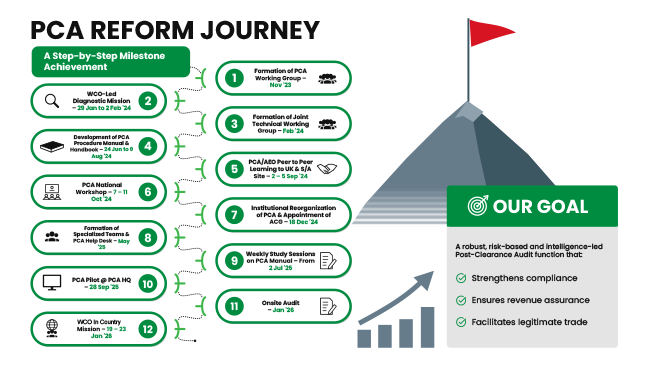
A key milestone was the WCO diagnostic mission conducted from 29 January to 2 February 2024. WCO experts assessed the PCA framework and, together with their NCS peers, drafted a comprehensive PCA Enhancement Action Plan comprising 35 strategic actions structured around five core pillars: Risk Management, Legal Framework, PCA Operational Procedures, Stakeholder Engagement, and Human Resources Development.
Restructuring the PCA function
In furtherance of these reforms, the then Chairman of the NCS Board and Coordinating Minister of the Economy, Wale Edun, approved on 20 December 2024 a strategic restructuring of the PCA function, aimed at strengthening institutional independence, operational efficiency, and governance within the audit framework. The PCA Unit was elevated from the Tariff and Trade Department and repositioned as a dedicated PCA Headquarters reporting directly to the Office of the Comptroller-General of Customs (CGC).
This represented a major institutional milestone in the Service’s modernization journey, reflecting the growing importance of intelligence-driven, compliance-management and risk-based audit systems within the NCS. The newly established office is headed by an Assistant Comptroller-General of Customs (ACG), supported by senior management officers overseeing administration and operations, respectively. This leadership structure has significantly enhanced operational coordination, accountability, decision-making processes, and administrative oversight within the PCA framework (see Figure 2).
On 20 December 2024, the CGC approved the restructuring of the PCA function. The restructuring significantly strengthened operational independence, enhanced governance structures, and improved institutional accountability within the PCA framework.
The clear separation between operational PCA responsibilities and tariff policy functions introduced stronger checks and balances. The new structure also improved coordination among PCA units and oversight of audit activities nationwide. Additionally, establishing dedicated Administration and Operations leadership structures further improved organizational efficiency and operational supervision within the PCA Headquarters.
Related projects
The PCA reforms within the NCS have complemented broader Customs modernization initiatives, particularly the Authorized Economic Operator (AEO) programme and risk management reforms, also supported by the WCO. As part of the AEO pre-qualification process, PCA staff participated in on-site audit exercises to assess AEO applicants’ compliance levels.
Building capacity and transferring knowledge
In sustaining an effective and modern PCA framework, the NCS recognizes the importance of multidisciplinary expertise. The PCA teams must gain professional competencies in classification, valuation, origin, accounting, auditing, ICT, data analytics, artificial intelligence, and financial analysis.
To strengthen the competence and analytical capacity of its personnel, the NCS benefited from technical support from the WCO, the World Bank Group (WBG), and other Customs administrations. A major milestone was NCS PCA staff participation in a peer-to-peer learning programme with the South African Revenue Service in September 2024, through the WCO Trade Facilitation Acceleration Programme. NCS officers learned about SARS audit procedures, compliance management systems, intelligence-led operations, and risk-based audit selection methodologies. They directly experienced how globally accepted PCA operational models work in practice, how to apply compliance verification techniques, and how to coordinate audit processes. In addition, WCO and WBG experts provided PCA officers with hands-on guidance on audit planning, data analysis, compliance assessment, documentation standards, and operational coordination.
To institutionalize knowledge sharing and deepen operational understanding, the Service also organized learning sessions across PCA Zones and Commands nationwide, enabling them to exchange practical experiences. The initiative also aimed at enhancing operational consistency and inter-Command collaboration. Moreover, to support sustainability and institutional continuity, the Comptroller-General of Customs, Bashir Adewale Adeniyi, approved a strategic retention policy, allowing selected experienced officers to remain at PCA Headquarters beyond routine transfer cycles. This initiative enabled the Service to leverage institutional expertise to mentor and coach younger officers, while strengthening succession planning and long-term capacity development.
Building on this momentum, the NCS organized a PCA sensitization programme for its auditors and key stakeholders, from 10 to 15 September 2026. The objective was to further reinforce understanding of PCA processes, standards, and best practices among officers and stakeholders alike, ensuring alignment with global compliance benchmarks and strengthening the Service’s overall audit capacity.
Developing new tools and systems
The NCS also initiated the development of operational tools, procedural systems, and technology-driven compliance mechanisms. In February 2024, it established a Technical Working Group (TWG) to develop a comprehensive PCA Procedure Manual aimed at standardizing audit operations and aligning procedures with international best practices. Following extensive technical engagement and drafting sessions between June and August 2024, the Manual was approved in November 2025 and subsequently distributed across PCA Zones and Commands for implementation.
Turning reform into results
The cooperation further enhanced the Service’s capacity to concentrate audit resources on high-risk entities and consignments. For example, a risk related to the importation of Linear Alkyl Benzene Sulphonic Acid (LABSA) flagged by the B’Odogwu system facilitated the recovery of 1,314,756,723.00 Naira from five companies, while an additional 600,000,000 Naira was recovered from a sixth company, following the discovery of incorrect tariff classification practices.
Strengthening traders’ engagement
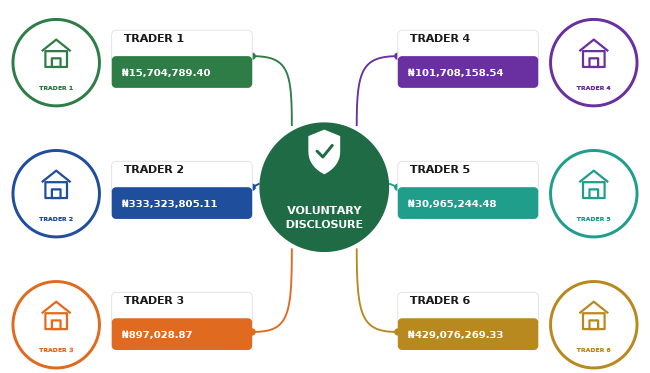
Since the establishment of the PCA Headquarters, the number of voluntary disclosures among traders has increased, reflecting a better understanding of Customs regulations, improved stakeholder confidence, and greater trust in the transparency and fairness of the PCA process. This, in turn, has maximized revenue collection (see Figure 3). For example, a trader disclosed a declaration mistake, leading to the collection of 482,000,000 Naira.
Monitoring, challenges, and continuous improvement
Data shows that, despite significant progress, the NCS continues to face challenges, including bureaucratic bottlenecks, funding limitations, and the ongoing need for specialized capacity development. Sustaining reform momentum during institutional and leadership transitions also remains critical to the long-term sustainability of the PCA reform programme.
To address these gaps, the NCS continues close collaboration with the WCO, WBG and other development partners. The Service is also intensifying nationwide sensitization programmes to improve trader compliance and increase awareness of PCA procedures, obligations, and voluntary compliance mechanisms. Future reform priorities include developing a robust PCA case management system, deeper integration with risk management processes, and continued enhancement of data-driven audit systems through the B’Odogwu platform.
Lessons learned
The NCS PCA reform journey demonstrates the importance of strong leadership commitment, institutional restructuring, a formidable legal framework, and sustained technical support in advancing Customs modernization. Diagnostic missions, strategic action planning, and technical assistance programmes coordinated by the WCO and supported by development partners have provided a strong foundation for institutional strengthening and reform implementation. The experience also highlights the value of continuous capacity development, peer learning, stakeholder engagement, and institutional ownership in sustaining long-term reforms.
More information
Contact the Nigeria Customs Service Public Relations Unit