
Logical step
This initiative is seen as the next logical step to extend Customs-Business partnership to the understanding of Customs law itself.
The relationship between Customs authorities and economic operators has undergone a profound transformation over recent decades. In the EU, Customs supervision evolved from examining individual consignments, to assessing the reliability of an operator’s compliance systems. Compliance came to depend not only on accurate declarations, but also on effective internal processes. The introduction in 2008 of the Authorized Economic Operator (AEO) programme gave formal legal expression to the evolving relationship between Customs authorities and economic operators. In 2016, the Union Customs Code (UCC) established a harmonized framework recognizing traders that demonstrate compliance, financial solvency, reliable record keeping and, where appropriate, supply chain security. The Trust and Check Trader (TCT) certification introduced by the EU Customs Reform takes this approach further by allowing highly compliant traders to release goods without prior Customs intervention, with authorities relying on continuous access to commercial data and post-release oversight. The scheme therefore marks a further shift of operational responsibility from Customs authorities to trusted economic operators.
In the EU, partnership with economic operators has also extended into the development of Customs policy, where practical expertise is essential for developing legislation and implementing increasingly complex Customs rules. This cooperation is institutionalized through bodies such as the Trade Contact Group, which contributes to legislative initiatives, implementation of the UCC and the development of electronic Customs systems. Business representatives have also participated in project groups preparing the UCC Implementing and Delegated Acts, while digitalization has strengthened cooperation through consultation on the Union’s Customs IT infrastructure. Similar structures operate nationally, such as Lithuania’s Customs Consultative Committee.
The EU Customs Reform extends collaborative governance into a new institutional dimension through the establishment of the EU Customs Authority, responsible for coordinating Customs risk management, data analysis and implementation across the Union. It also creates a Customs Advisory Board, bringing together representatives of the business sector and other stakeholders to advise the Authority on technical, operational and implementation issues. Unlike earlier consultation mechanisms, which focused on legislation, the Customs Advisory Board gives stakeholders a permanent role in the governance of EU Customs administration.
The Board, however, does not address the lack of similar approaches to classification, valuation and other Customs matters across Member States.
The next stage: establishing a European Customs Knowledge and Practice Hub
The idea to establish a business-academia group emerged at the 2025 Customs Ecosystem Conference, which culminated in the adoption of the Vilnius Manifesto. [2] The Manifesto calls for the potential establishment of a European Customs Knowledge and Practice Hub, among other goals. Bringing together representatives from Customs administrations, the private sector and academia, the Hub would build and maintain a common professional foundation, set forward-looking knowledge standards, keep knowledge current as the law changes, and draw on advanced technology to make this possible at the scale of 27 Member States. It is not seen as a training provider competing with existing public or private offerings, but the connective framework within which a common understanding is reached and maintained. No single administration, trainer or association can deliver this alone: business knows how goods actually move, Customs knows how the rules are meant to work, and neither side alone holds the full picture.
And the Hub has, for the first time, a natural institutional anchor. The EU Customs Authority will be a permanent, Union-wide institution, designed to endure beyond funding programmes, political cycles and generations of Customs professionals – precisely the stability required to support a common professional foundation. While the reform does not explicitly assign this role to the Authority, it creates the opportunity for it to assume it. This would not place an undue burden on the Authority, as responsibility could be distributed by design. The Authority could provide what only a permanent public institution can offer: strategic leadership, continuity and convening power. At the same time, the private sector, academia and educational technology providers could lead – and, where appropriate, take full ownership of – the activities and outcomes that are closest to their respective areas of expertise. Nor would this require the Authority to take on something new. While the reform does not name a Knowledge Hub as such, its founding tasks already point in this direction – pooling and providing technical expertise, preparing common training content for Customs officers, contributing to a Union recognition system for the universities and schools that educate the profession, fostering research and innovation, and issuing common operational guidance – with most operational work continuing to be done, as the proposal puts it, “boots on the ground” by national administrations. Like the Authority itself, the Hub would be an enabler, not a replacement. The reform opens up new opportunities, and there is real potential in joining forces to seize them.
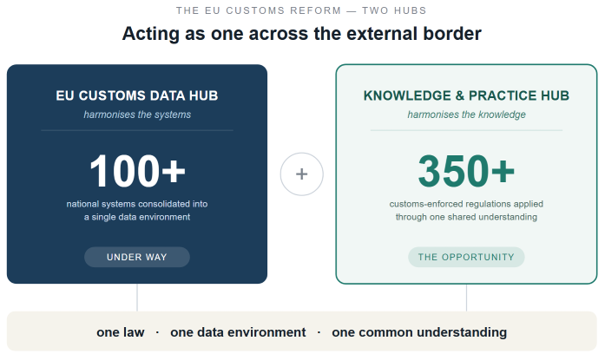
The European Customs Knowledge and Practice Hub is thus the natural counterpart to the Data Hub: the one establishes the systems through which Customs data moves, the other the knowledge through which the law is understood and applied. If responsibility for compliance is increasingly shared, knowledge itself must become a shared resource – and building it together is that partnership carried to its logical end.
Way forward
The evolution traced in this article is one of growing partnership. Administrative audits made operators’ systems part of Customs supervision. The AEO programme transformed demonstrated compliance into recognized trust, while TCT extends this partnership by allowing trusted traders to assume greater operational responsibility. The next logical step is to extend this partnership to the understanding of Customs law itself.
The reform’s ultimate objective is not only harmonized legislation and centralized data, but also more consistent application of Customs law. Shared professional knowledge would reduce divergent interpretations, increase legal certainty and lower compliance costs, particularly for SMEs, while strengthening the competitiveness of the Customs Union.
Although rooted in the EU reform, the idea travels: Gerassimos Thomas calls the reform “a global blueprint for Customs modernisation”, and pairing a shared data environment with shared professional knowledge is a principle any Customs union can adapt.
Achieving this raises practical questions: how to measure convergence in legal interpretation; what common professional standards should look like; how Customs education should adapt to an increasingly digital profession; and how voluntary certification can support consistent application across the Union. The European Customs Knowledge and Practice Hub would address these questions through continued cooperation between Customs authorities, business, academia and other stakeholders.
These are questions to be worked through together, and that conversation is only just beginning. The concept was introduced to the Commission through the Trade Contact Group in April 2026 and is shared here for wider discussion – an invitation to shape, together with the Authority and all interested parties, how it might be taken forward.
The moment is particularly favourable. As the EU Customs Authority and the implementing framework take shape, the Union has an opportunity to complement enhanced data analysis with harmonized professional knowledge. Completing this final stage would help realize the reform’s broader vision: one law, one data environment and one common understanding across the Customs Union.
Interested parties – Customs administrations, trade associations, universities and training providers, and technology partners – are warmly invited to join the conversation: to register their interest, share practical experience and cases, and help shape how the idea might be taken forward. A first practical step is already envisaged: existing EU funding programmes could support an initial joint project, giving early momentum to whatever is agreed from the discussion.
More information
Contact the authors
[1] The article is a shortened version of the article “A second hub for the EU Customs Reform: partnership for a shared understanding of EU Customs Law”, prepared for publication in Global Trade and Customs Journal, Volume 21, Issue 10.
[2] The Vilnius Manifesto on the Future of the European Customs Ecosystem, available at https://www.lcpa.lt/file/repository/Vilnius_Manifesto_2025_6_2_2026.pdf