

Adding the technology stack
The INCB contributes to the WCO initiative through its Global Rapid Interdiction of Dangerous Substances (GRIDS) Programme, which coordinates the development of science-based resources, technologies and training for the safe interdiction of fentanyl opioids, specifically designed for front-line officers operating in postal and express courier channels. INCB GRIDS provides the operational technology stack that helps officers and analysts connect information across borders in real time. The objective is to reduce the time between detection, information-sharing and coordinated action. In a world where traffickers move at digital speed, the Customs response must move faster than the next parcel on the conveyor belt.
Incident communication system
While the large volume of consignments handled by Customs officers may be seen as a vulnerability, it also provides an opportunity. The identification of routing patterns, methods used by senders and recipients, concealment techniques and other indicators can be turned into actionable intelligence if captured and shared quickly enough.
At its core, GRIDS is based on the principle that every seizure or suspicious shipment should become a global signal. The IONICS (Project ION Incident Communication System) suite is the secure communication and targeting backbone that enables seizure information to travel faster than traffickers. It is designed for real-time communication of incidents involving suspicious shipments, trafficking, manufacturing or production of NPS, fentanyl-related substances and other synthetic opioids and related chemicals. The result is not simply “reporting” but actionable coordination among governments and international agencies, including Customs risk analysts and postal operators’ security officers.
Supporting analysts and front-line officers
In 2025, 14,204 incidents related to postal shipments were reported via IONICS, with opioids being the most frequently seized NPS (21%). INCB tools, paired with other international and national systems and training, provide a stronger basis for answering operationally critical questions: Am I seeing a new route emerge? What is this new substance, and is it increasing in my region or at my borders? Is a particular chemical appearing in contexts other than legitimate use? Are concealment methods changing in ways that require retraining?
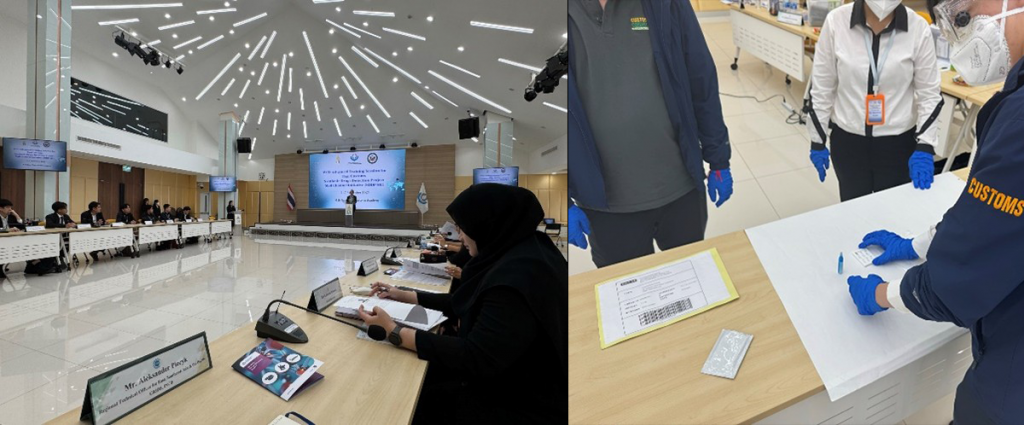
To improve the capacity of front-line officers, the INCB also delivers, through its GRIDS Programme, science-based training on safe interdiction approaches, information exchange and the development of actionable intelligence. It also supplies personal protective equipment (PPE) and field test kits to law enforcement, regulatory and Customs agencies. Training materials are available in all UN languages and more.
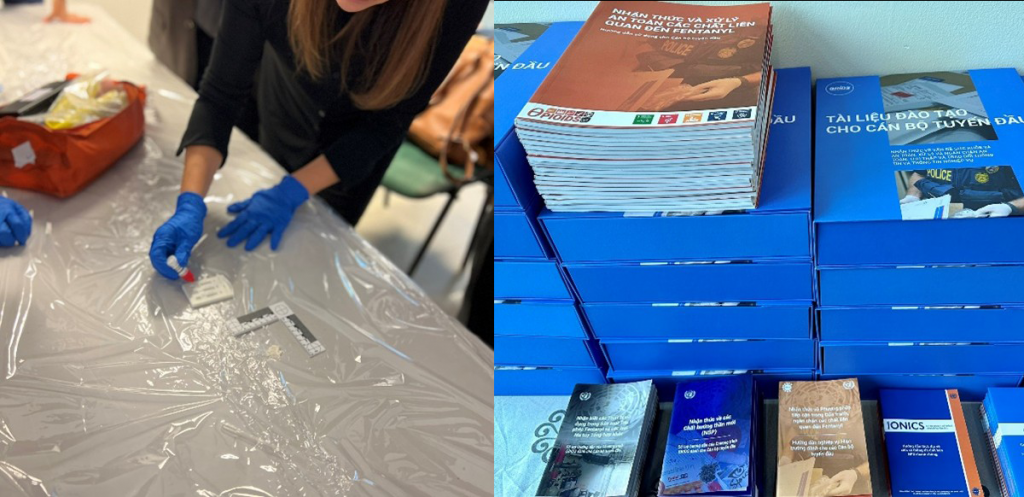
One of the main challenges consistently observed is the high turnover of trained personnel, including changes due to promotions, reassignments, or departmental rotations. This requires continuous efforts to:
This dynamic underscores the importance of sustained engagement and regular capacity-building to maintain an effective and informed user network.
Scanning novel opioids on online platforms
Traffickers exploit not only postal channels but also digital marketplaces, using e-commerce platforms to sell and distribute dangerous substances globally. The INCB’s SNOOP (Scanning Novel Opioids on Online Platforms) tool provides enforcement officers with an AI-powered system that monitors online marketplaces continuously and identifies suspicious wholesale vendors of synthetic opioids and related chemicals. It enables investigators to identify vendor and shipper details, flag risk indicators and consolidate payment and trafficking information to support detection and disruption at borders, as well as the dismantling of supply sources.
Results
The GRIDS Programme facilitates both automated and targeted communications. For example, the IONICS platform generates daily automated notifications for users, sharing incidents relevant to their respective countries. In addition, the GRIDS Cyber-Communications Centre disseminates alerts and notifications on emerging substances, trends and operationally relevant developments.
Information exchanges via IONICS have proven their value. In 2025 alone, 53 information packages shared through this system initiated government investigations or resulted in the dismantling of NPS trafficking organizations.
For example, in 2025, analysis of IONICS incident data on intercepted postal parcels containing hazardous substances enabled the identification of at least 13 similar shipments of psychotropic and opioid pharmaceuticals originating from Macaé (Rio de Janeiro State, Brazil) and destined for multiple addresses in the United States. Intelligence sharing between U.S. Customs and Border Protection (CBP), the Brazilian Federal Police and the United States Drug Enforcement Administration (DEA) led to the launch of a coordinated investigation and subsequent enforcement action.
The most recent operational success was recorded in March 2026, when Brazil’s Federal Police dismantled an international synthetic drug trafficking network. Once again, the investigation was directly triggered by intelligence derived from IONICS incident reporting, specifically postal parcel interceptions involving dangerous substances.
An alert generated by the GRIDS Cyber-Communications Centre, based on AI-supported analysis of 15 IONICS incidents shared by US authorities, identified suspicious postal shipments intercepted by CBP and the United States Postal Inspection Service (USPIS). These incidents constituted the primary intelligence lead that initiated the investigation.
The operation targeted a sophisticated criminal network exploiting online platforms to distribute synthetic opioids and benzodiazepines in pharmaceutical form through international postal channels. Law enforcement authorities executed search warrants at three locations, resulting in multiple arrests and the seizure of drugs, mobile devices and documentary evidence.
Operational analysis enabled authorities to map more than 900 shipments linked to the network, with distribution routes extending to the United States, Canada, Australia and the Czech Republic. A related cocaine seizure connected to the same address further exposed the scale and diversification of the criminal activity.

Upcoming developments aimed at automation
Another tool, the GRIDS Pre-flight Incident Notification Gateway (PING), is under development. It will allow international organizations or national government with IONICS access to automatically check whether a specific importer or exporter geospatial coordinates are associated with suspicious shipment or seizures dangerous substance reported via IONICS.
It was developed to allow the future Universal Postal Unions (UPU) Dangerous Good Search Tools (DGST) to ping IONICS signals and instantly obtain a stoplight match score for potential secondary inspection of shipments before they are loaded onto aircraft. Currently under development, the DGST uses machine learning to analyse postal EDI messages and aims to connect with external systems and databases to improve predictive capabilities.
PING automates what is currently possible manually by focal points without the burden of data exchange and could be expanded to connect with other systems and tools as it could handle millions of pings daily.
How to join GRIDS
The INCB GRIDS Programme currently includes 5,751 registered focal points worldwide, representing a broad range of actors such as Customs, police, postal services, express carriers and health authorities.
Access to GRIDS tools is facilitated through official government nomination. Customs administrations interested in accessing the tools are encouraged to coordinate with their national authorities or contact the INCB directly for guidance through the nomination and onboarding process.
More information
https://www.incb.org/incb/en/grids.html
incb.grids@un.org