
 The use of non-intrusive inspection (NII) equipment for container control purposes has gradually emerged as a key measure for modernizing the work of Customs administrations around the world. Against a background of increased trade, the growth in transnational crime networks and the demand for greater logistical fluidity, Customs administrations are now having to reconcile measures to promote the effectiveness of controls, secure the international logistical chain and facilitate trade.
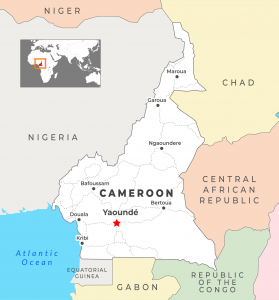
With a view to meeting these objectives, a scanning mechanism has been developed for inspecting containers at Cameroon’s ports. At the Port of Douala, the system has gradually evolved since 2016 from a targeted control mechanism based on risk analysis to an almost systematic model for scanning containers on import and export. This article analyses the various phases of implementation of the container scanning system at the Port of Douala, the technologies mobilized, the operational and economic repercussions observed and the outlook for the mechanism’s further development.
Background to and development of the scanning mechanism at the Port of Douala
The introduction, back in 2005, of a procedure for scanning containers at the Port of Douala was part of a developing strategy to modernize Customs inspections and measures to secure trade flows.
This reform was introduced in the course of the adoption by the World Customs Organization of the SAFE Framework of Standards to Secure and Facilitate Global Trade. Among the measures promoted under the Framework are the use of non-intrusive inspection techniques and an enhanced risk management strategy.
The mechanism originally relied on the use of a mobile scanner positioned at the end of the Customs clearance procedure for targeting high-risk containers. The scanner was the pivotal component in a partnership established between the State of Cameroon and a company specializing in goods inspection.
In a significant development, the Government of Cameroon decided in October 2016 to set up a systematic procedure for inspecting containers on their import and export. To satisfy that requirement, the original mobile scanner was replaced with two large-capacity fixed scanners for inspecting import operations.
In July 2017, a device for scanning exports was installed with a view to extending inspections to all outward flows. The mechanism was subsequently upgraded in July 2021 with the installation of a second export scanner positioned outside the container terminal, its operations coming on stream in March 2022.
Since then, Douala Port’s scanning system has been operating across practically all containers both on import and on export.
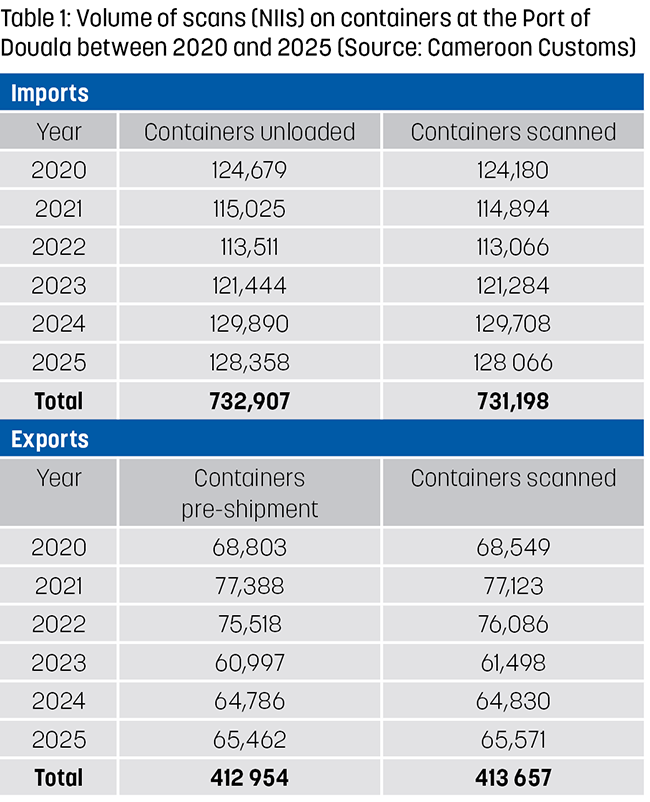
Analysis of this data shows that the almost full scanning target is met globally, even though some container categories are still not subject to this procedure. The discrepancies noted on import are mainly explained by the existence of specialized containers which, on account of their technical configuration or dimensions, cannot be presented for scanning, such as flat rack containers with no side walls, open top containers without a solid roof, tank containers and outsized shipments. These consignments are usually subject to a physical inspection by Customs services.
In terms of exports, since 2022 the number of scanned containers appears to exceed slightly the number of containers actually shipped out. This situation can be explained by the fact that only those containers that have been scanned beforehand are admitted into the export terminal, while some shipments may ultimately be removed or withdrawn for different commercial or logistical reasons: breach of contract, cancellation of the export procedure or change of packaging.
Technology architecture and systems integration
The system used at the Port of Douala relies on an integrated technology architecture connecting X‑ray scanners, digital platforms and artificial intelligence tools.
The four high-capacity scanners currently in operation at the port are each capable of processing up to 100 containers per hour. The data generated is stored centrally on a digital platform developed by the operator to ensure that the information coming from different manufacturers’ equipment is managed in a consistent manner.
Recent integration of artificial intelligence solutions has significantly strengthened the analytical capabilities of Customs services through the application of image interpretation, automated anomaly detection, predictive modelling by reference to HS codes and automated cross-referencing of declaration data and scanner images.
The D-TECT platform is interconnected with various information systems operating in the port environment, such as the CAMCIS (Cameroon Customs Information System) portal for Customs matters, the container terminal operating system NAVIS and the Single Window for External Trade platforms.
The benefits of these interconnected systems are that information can flow quickly and support can be given for the further development of an integrated digital environment for overseeing external trade.
Operational repercussions and Customs performance
The wider rollout of scanning operations has fundamentally transformed Customs control methods at the Port of Douala.
Immediately after their unloading, containers are moved to inspection sites where the scanner images are automatically compared with the data on the manifest and Customs declarations. This centralized information solution provides inspectors with a streamlined analysis facility for detecting instances of fraudulent concealment, identifying false declarations, targeting consignments requiring physical inspection and enhancing risk management.
Over the years, the use of scanner images has become a valuable tool in support of the decision-making of front-line inspectors, Customs re-inspection services and risk management units.
In 2025, almost 90% of declarations subject to correction in the Littoral 1 Customs sector were detected as a result of scanner image use. In the absence of such images, the control operations would most likely have resulted in corrections which were less targeted – and possibly less effective – and took longer to establish.
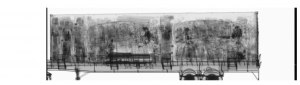
This image shows a container on import; only the vehicles it was carrying had been declared in the Single Administrative Document (Document Administratif Unique (DAU)). This document sets out all the information needed for importing the goods concerned and, on despatch, triggers the clearance process per se in the CAMCIS system. Following verification of the images, the inspector handling the declaration discovered other goods in the container, whereupon the ensuing physical inspection identified the types and quantities of those goods and, consequently, the Customs duties and taxes payable.
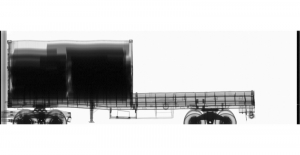
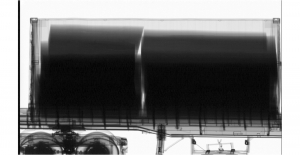
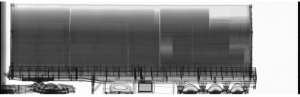
The two images above show two containers filled with (squared) logs, although the shipment had been declared for Customs purposes as sawn timber in order to benefit from the associated Customs duty and tax exemption. Additional duty and taxes were payable in respect of these containers following verification of the scanner images and establishment of the discrepancies. For comparison purposes, the image below shows a container of sawn timber.
Furthermore, the Customs sector with responsibility for the Ports of Douala feature prominently in the budgetary performance of Cameroon Customs.
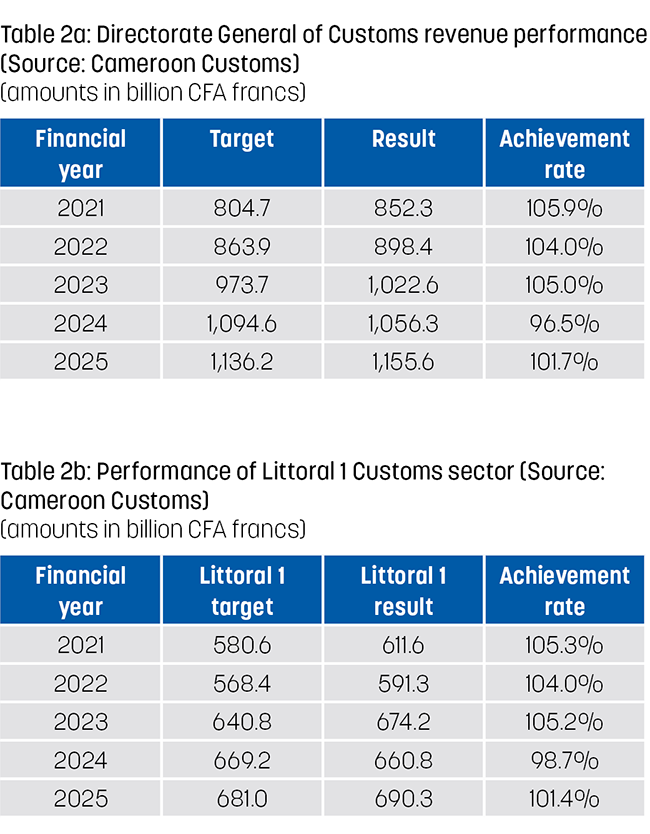
These results highlight the central role played by the Port of Douala in generating national Customs revenue. Scanning contributes to this performance by improving the detection of tariff fraud, enhancing value verification, identifying undeclared goods and safeguarding the tax base.
That said, it is still difficult to measure the impact of scanning measures on trade facilitation in a comprehensive manner. The data nonetheless shows a gradual improvement in the timescales needed to process declarations despite the increase in trade volumes. In 2025, the average time required for processing declarations associated with scanned containers was estimated at some 1.2 days. However, the mechanism is still subject to potential disruption. It is apparent from the difficulties arising during the first quarter of 2026 in the “scanners crisis” that technical or contractual failings can have an immediate knock-on effect on port fluidity and clearance timescales.
Mechanism limits and challenges
In spite of these positive results, the container scanning system at the Port of Douala is facing various challenges.
Some of the major limitations include the technological dependence on a private operator, congestion risks in the event of equipment breakdown, inadequate management of outsized shipments, the increasing need for specialist maintenance, the need for the continuous training of image analysts and the cyber-security challenges associated with the interconnection of digital systems.
The systematic inspection of containers also raises the issue of maintaining a balance between trade security and trade facilitation. Imposing controls too broadly could result in logistical slowdowns if technical and human capabilities do not keep up with changes in trade flows.
Outlook
The outlook for developing the scanning mechanism at Cameroon’s ports is part of a rationale promoting digital transformation and inter-administrative integration.
In line with its contractual obligations, the scanning operator at the Port of Douala plans to set up a national centralized platform for pooling analysis functions and sharing data between several administrations, including Customs, the port authorities, the police, the gendarmerie and other inspection and monitoring services. This project comes under the dynamic process for modernizing the Single Window of External Trade Operations and is intended to create a fully‑fledged external trade digital ecosystem.
A platform of this nature would facilitate, for instance, the automatic transmission of scanner images, secure access to data by authorized administrations, traceable and actionable archive storage, the rollout of joint inspections and more effective intelligence sharing.
Future developments should also focus on broadening artificial intelligence capabilities, improving automated detection systems, developing smart warning solutions following data cross-referencing and upgrading mobile equipment to accommodate outsized shipments. These changes will need to be accompanied by measures to strengthen Customs officers’ technical and analytical capabilities.
More information
Contact the author