

Three years ago, we wrote in these pages about the security crisis in Haiti and its impacts on Customs. Today, as the crisis continues, stifling the Haitian economy by increasing the cost of international trade transactions, we would like to revisit certain strategies and outline the results achieved so far.
Haiti is a small economy dependent on international trade for manufactured goods and food products, and it remains engulfed by violence. Gangs control around 80% of the metropolitan area of Port-au-Prince, including the entire coastline of Port-au-Prince Bay where the port, its terminals, the Customs office, warehouses, Customs clearance areas and fuel storage facilities are located. Two armed groups also control the road leading to the Malpasse border Customs office, situated 50.4 km from the capital on the border with the Dominican Republic.
Customs resilience is more essential to the country than ever. Customs must collect the revenue needed to finance the State; regulate trade flows and protect domestic production against unfair competition from smuggling; and reduce insecurity and violence by combating illicit trafficking and crime.
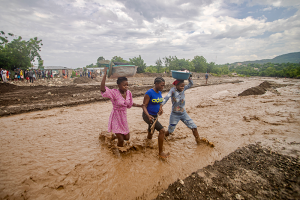
Moreover, Hurricane Melissa, which struck the south of the country in October 2025, once again highlighted the critical role played by Customs in emergency situations. Following the activation of Article 182(6) of the Customs Code, which authorizes the duty- and tax-free importation of goods intended for distribution to victims of natural disasters or for use on their behalf, joint teams comprising representatives of the Ministry of the Economy and Finance, the Directorate of Civil Protection and the Quarantine Service and Customs officials worked tirelessly around the clock to deliver foodstuffs, medicines, clothing and tents to affected populations, removing the usual administrative obstacles in view of the humanitarian emergency.
The 2,150 officials of the General Customs Administration of Haiti (Administration Générale des Douanes – AGD) operate in a dangerous environment. The Directorate General was relocated to the airport office after gangs took control of the port area. Officials assigned to the port rotate between the terminals and the airport in order to ensure continuity of operations.
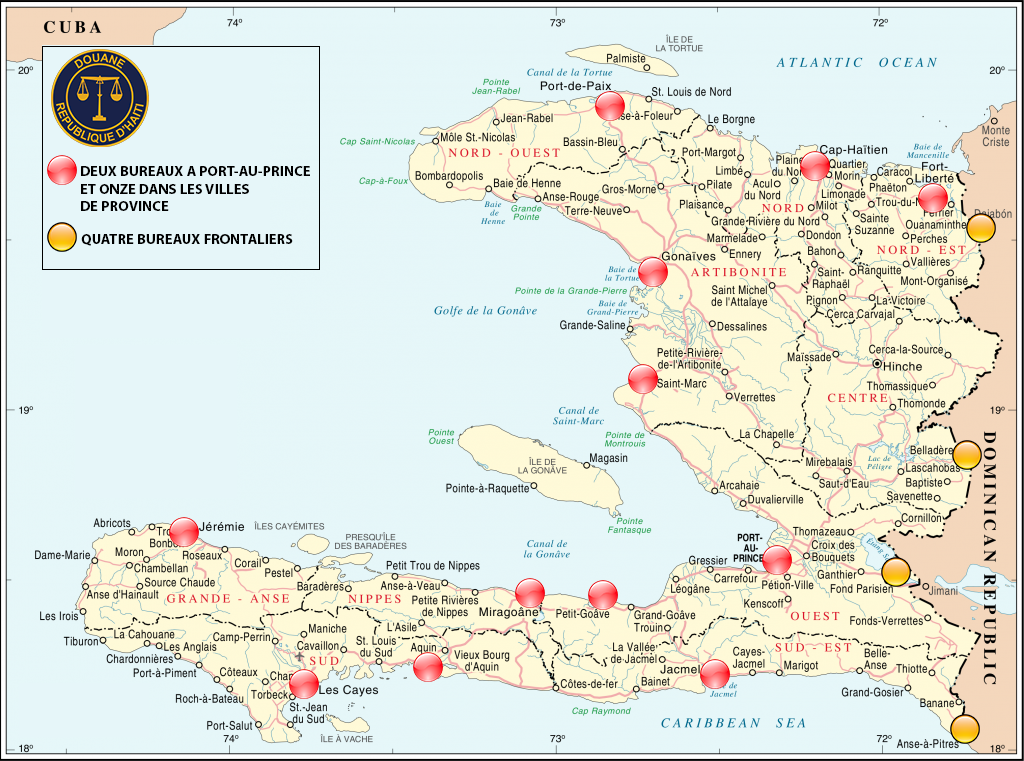
Despite these constraints, the 17 field Customs clearance offices remain operational, 12 of which are located at ports and airports and four along the land border. In addition, there are nine local offices in free zones, and six road checkpoints monitoring the movement of goods and persons.
 Systematic inspection of imported goods
In response to the security crisis, the AGD introduced systematic physical inspections of imported goods, temporarily suspending the green channel normally granted to operators with an established compliance profile, while maintaining specific facilitation measures for operators whose risk profile is considered under control. This exceptional measure is intended to be lifted as soon as the security situation permits.
Remote working and off-site inspections
In order to maintain continuity of service during the crisis, the AGD authorized remote working via ASYCUDA and physical inspections of goods at operators’ premises, with the operators providing armoured transport for officials. These measures remain in force and raise corruption risks, which the AGD seeks to mitigate through the digital traceability of operations and the rotation of officials assigned to off-site inspections.
Digitalization and facilitation measures for trusted operators
The security situation and the inspection measures introduced have contributed to longer border clearance times. To address this issue, a new Customs Code entered into force in March 2023, enabling the implementation of significant facilitation measures for economic operators.
Among the most significant developments are the digitalization of supporting documents and their upload to the Customs IT system together with Customs declarations, in accordance with Article 95(1) of the Code. Together, these measures have considerably reduced processing times and strengthened the traceability of operations.
In addition, a Memorandum of Understanding between the Ministry of the Economy and Finance, the Association of Haitian Industries and the Chamber of Commerce and Industry of Haiti established a derogatory Customs facilitation regime for the industrial sector. The regime is reserved for operators engaged in recognized activities, which are members in good standing of the signatory organizations, have a satisfactory compliance record and agree to post-clearance controls, thereby ensuring that the facilitation granted does not undermine the integrity of the control system.
Eligible companies benefit in particular from:
In order to benefit from these facilitation measures, companies must provide a comprehensive guarantee covering all of their Customs obligations.
Significant increase in revenue
Revenue increased significantly in 2023, partly owing to operational difficulties at the Port-au-Prince and Malpasse Customs offices, which led operators to use entry points that were better controlled.
A comparison of certain indicators for the period from October 2022 to April 2023 and the period from October 2025 to April 2026 reveals remarkable growth.
The number of containers processed rose from 35,171 to 42,033, representing an increase of 19.5%, while the total volume of goods rose from 1,880,513 tonnes to 2,641,319 tonnes, an increase of 40.5%, reflecting not only a rise in the number of declarations but also a substantial increase in cargo density.
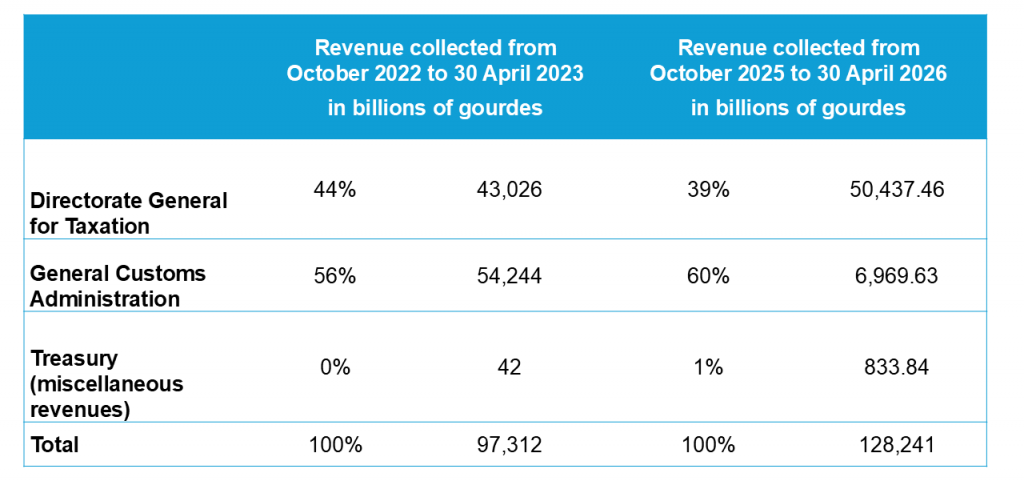
The revenue figures are equally striking. Duties and taxes collected now amount to approximately 11 billion gourdes per month, equivalent to more than USD 84 million, representing 60% of state tax revenue, an increase of four percentage points. This increase is all the more significant given that it occurred in a context where the exchange rate appreciated, moving from 156 gourdes to 130.75 gourdes to the US dollar. The increase in revenue therefore reflects a genuine expansion of the tax base for duties and taxes, as well as structural improvements in collection efficiency.
Three flagship measures
Three initiatives produced tangible results during the period under review:
Future prospects and new initiatives
The results achieved testify to remarkable institutional resilience, but they should not obscure the scale of the challenges that remain to be addressed. Beyond the measures already introduced, the AGD is continuing its modernization drive by launching new initiatives aimed at facilitating trade, broadening the tax base and strengthening security.
Strengthening staffing levels within the Customs Surveillance Directorate
The Customs Surveillance Directorate is responsible for verifying the compliance of international trade operations, monitoring entry points and ensuring the safety of personnel and infrastructure. It is organized into services, sections and mobile units.
 The inspections carried out by this Directorate are aimed, in particular, at stemming violence by combating the trafficking of arms, ammunition and equipment. Seizures carried out between October 2025 and April 2026 at Haiti’s ports and airports resulted in the interception of the following:
Officials perform their duties under difficult conditions, and staffing levels are often inadequate. Management of the border with the Dominican Republic – Haiti’s second-largest trading partner, from which imports have increased significantly in recent years – is particularly challenging. At Ouanaminthe, the second most important crossing point with the Dominican Republic, staffing levels are well below what would be required for effective border surveillance. During periods of drought, the Dajabón River, which forms the natural border between the two countries, becomes little more than a symbolic obstacle, as water levels fall sufficiently for it to be crossed on foot, by motorcycle or by donkey.
The AGD plans to deploy more mobile units, since these play an integral role in strengthening the credibility of the Customs system and building trust among economic operators and international partners. The recruitment drive will be supervised by the Human Resources Management Office and will follow a transparent and merit-based procedure involving a public call for applications, the submission of documents demonstrating that candidates meet the required qualifications, a written examination and an interview before an independent panel, followed by mandatory training at the National Customs School. This training will include a module on weapons handling and security protocols, reflecting the constant demands of the profession.
The aim of this merit-based recruitment drive is to train officials who act with integrity and who are capable of dealing with the pressures they will face. Yet a number of real problems have emerged in this connection, in particular a lack of good candidates, geographical limitations and low salaries which make the jobs less attractive, as well as the fact that most officials are male and women account for only around 27% of applicants.
Physical modernization of border posts and technological tools
In view of disparities between border offices in terms of equipment, levels of digitalization and facilitation measures, the AGD is embarking on a programme of physical modernization aimed at upgrading all of the country’s entry and exit points, deploying advanced inspection technologies and improving working conditions for staff as well as reception conditions for users and economic operators. The objective is to guarantee a Customs experience that is both uniform and compliant with international standards.
In particular, the mobile units will need to be equipped with surveillance drones, night-vision goggles and mobile non-intrusive inspection technology.
Planned installation of non-intrusive inspection equipment in Cap-Haïtien and Ouanaminthe
The planned installation of non-intrusive inspection equipment in Cap-Haïtien and Ouanaminthe represents a significant step forward, although other measures will also be necessary to achieve a high level of operational efficiency in this connection, for example the increased presence of mobile units along uncovered trade corridors, a rigorous maintenance plan accompanied by training for local technicians, and enhanced physical protection for the equipment in the light of the tense security situation.
Improved risk management
In response to the structural vulnerabilities that facilitate smuggling, fraud and losses of tax revenue, the AGD is launching a new analytical risk management initiative linked to the ASYCUDA system and supported by international partners, with the aim of targeting high-risk operations and ensuring that officials are deployed where they are most needed.
Establishment of an interinstitutional border security platform
The fragmentary nature of the institutions responsible for border surveillance constitutes a critical weakness that criminal networks and armed groups exploit relentlessly. The establishment of an interinstitutional platform involving the Haitian National Police, the Directorate of Immigration, the Ministry of Agriculture, the Ministry of Public Health and other institutions operating at the borders has therefore become an imperative necessity. The platform would ensure the immediate sharing of intelligence among all the institutions involved, coordinate joint operations at the most vulnerable border crossing checkpoints and restore the effective monitoring of trade flows in order to curb illicit sources of funding that fuel insecurity.
Full deployment of the electronic Single Window and widespread use of online payment
The full deployment of the electronic Single Window and the widespread use of online payment pursue a dual objective: simplifying Customs formalities and reducing corruption risks linked to direct contact between users and officials. By introducing a single interoperable platform which centralizes all operations – declaration, verification, assessment and payment – and which interfaces with the IT systems of other key stakeholders, notably the Ministries of Agriculture, Commerce and Public Health, the Directorate General for Taxation and the Bank of the Republic of Haiti, the AGD aims to improve transparency and efficiency while providing economic operators with a smooth, traceable compliance process accessible from anywhere in the country with access to a telecommunications network.
More information
https://www.douane.gouv.ht
reginaldtimmer@gmail.com