

Why Customs needs a better chemical verification layer
Modern combined spectroscopy systems can help officers validate Harmonized System declarations, assess whether substances match shipping documentation, and reduce dependence on time-consuming laboratory workflows. Where tariff exposure, VAT treatment, anti-dumping enforcement, or precursor control depends on what a substance actually is, documentation alone may be insufficient.
The practical problem is not merely identification speed. It is decision quality. A fast but weakly supported answer has limited enforcement value. A rapid result with a stronger scientific basis gives officers a more defensible basis for action, especially when the result either confirms the declared material or reveals a discrepancy requiring escalation.
This is especially relevant in intelligence-led Customs environments. Connected field systems can transmit inspection outcomes to centralized platforms, allowing hits, inconclusive scans, and patterns of non-identification to support broader targeting and anomaly detection across ports and border crossings.
“The question is no longer only whether to deploy field chemical verification, but whether to build that capability on a platform modern enough to keep improving with the mission.”
What distinguishes a newer-generation platform from a legacy-era system
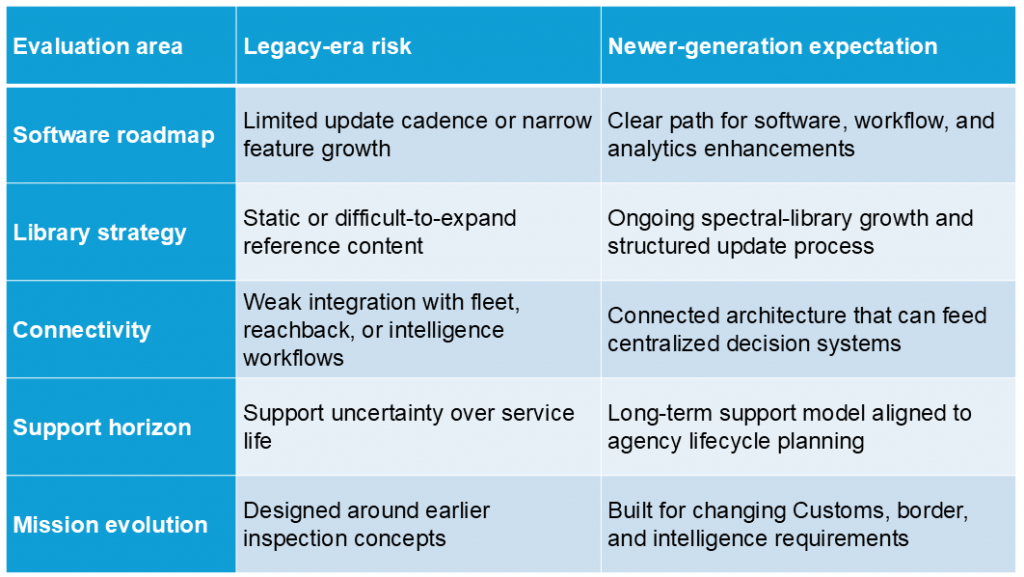
A Customs agency should treat field chemical verification as a lifecycle capability, not as a one-time equipment purchase. In practical terms, that means evaluating whether the platform can continue to improve after deployment through software updates, spectral-library expansion, algorithm refinement, workflow integration, and long-term vendor support.
Library breadth and quality materially influence field performance, and newly confirmed compounds can be added to improve future recognition capabilities. That feature has strategic implications: the value of the system compounds over time only if the platform and support model are designed to accommodate continuous enhancement.
For procurement teams, the gap between a newer-generation platform and an aging field-identification system is therefore not just about initial capability. It is about lifecycle headroom. Newer-generation systems are better positioned to support evolving information workflows, higher-fidelity data connectivity, refreshed libraries, and sustained enhancement cycles. Legacy-era systems may still function, but they were often designed for a different phase of the market and may offer less flexibility as mission demands change.
Operational benefits of field verification in Customs workflows
When officers can analyze a single sample at the point of inspection and compare the result to declared documentation, the workflow becomes more structured: inspect, verify, compare, escalate, or clear. That operational model is superior to a binary choice between accepting paperwork at face value and detaining everything that appears suspicious pending laboratory confirmation.
Non-matches and inconclusive results are operationally meaningful. If a declared compound should be present in the onboard library but the device does not identify it as declared, that discrepancy may justify further inquiry. If the field result is inconclusive, agencies can escalate the spectra to reachback or a forensic laboratory and then add the positively identified compound back into the system library, improving future performance.
This structure directly supports revenue protection. More accurate verification reduces undercollection risk tied to misclassification and helps agencies act sooner on shipments that appear mislabeled, diluted, substituted, or otherwise misdeclared. At the same time, confident field confirmation can reduce unnecessary delay for compliant trade.
Case study: operation black swan
In 2025, at the ports of San Antonio and Valparaíso, Chilean authorities identified suspicious commercial activity tied to shipments from Colombia. These shipments were then to be moved from the ports to Santiago International Airport, and subsequently by air to Australia. What at first appeared to be routine foreign trade transactions soon revealed a sophisticated drug-smuggling operation.
In this case, two field chemical verification devices were used, the first one for rapid trace-narcotics identification on surfaces and packaging, and the second one for more detailed identification of bulk chemicals and complex mixtures. Thanks to pre-defined information flows, results were shared between enforcement agencies through a dedicated platform, escalated, and acted on quickly across agencies.
The strategic significance of the case is broader than a single interdiction. It shows how Customs, investigative, and prosecutorial actors can combine field-deployable chemical verification with intelligence sharing and multi-agency coordination. It also shows why agencies that invest in modern platforms are not simply buying instruments; they are building an operational architecture in which rapid field results can trigger faster decisions, more focused escalation, and better cross-border coordination.
Implementation framework for agencies
A successful deployment program should begin with workflow design, not hardware selection. Agencies should define where field chemical verification adds the most value: port inspections, inland cargo checks, postal or express consignments, aviation cargo, precursor screening, or revenue-focused bulk chemical verification. The decision tree for match, mismatch, and inconclusive outcomes should be explicit before devices are fielded.
Training should cover interpretation and escalation, not just operation. Officers need to understand when a result is sufficient for release, when it supports detention or secondary inspection, and when it should be elevated to reachback or a forensic laboratory. This is consistent with the WCO model of connected enforcement in which field outcomes feed broader intelligence and adaptive screening practices.
Finally, agencies should treat support and enhancement as part of the acquisition itself. Procurement language should require an update pathway, library maintenance model, support commitments, and a plan for integration with fleet, records, or intelligence systems. That is the clearest practical way to separate a newer-generation platform from a legacy-era system whose value may plateau soon after deployment.
Conclusion
Modern Customs chemical verification is no longer simply a matter of obtaining faster field results. It is about improving frontline decision quality, protecting revenue, focusing laboratory resources, and generating better intelligence from every inspection event.
Agencies that are investing now should resist the temptation to treat field identification as a static equipment purchase. The better procurement question is whether the selected platform is modern enough to keep improving through software evolution, library growth, connectivity, and sustained support. That is the difference between solving today’s inspection problem and building tomorrow’s enforcement capability.
More information
mail the author
John Johnson, “Transforming Customs Enforcement: How Modern Spectroscopy Techniques Enable Revenue Protection,” WCO News 108, Issue 3, World Customs Organization, 28 October 2025.
908 Devices, “Operation Black Swan Breaks a 9,000-Mile Drug Trafficking Pipeline